Agreements, delegations, networks and joint projects: UTM strengthened its partnerships across Asia, Europe, the Arab world, Africa and within Tunisia. It signed cooperation agreements with universities in Japan, China, France, Oman and Algeria, took part in the Mediterranean alliance MARE, in Erasmus+ projects and in a regional hackathon, received delegations from several continents, and concluded agreements with civil-society organisations and public institutions in support of the Sustainable Development Goals.
Agreement with the University of Electro-Communications, Tokyo, and Japanese recognition
UTM signed a cooperation agreement with the University of Electro-Communications (UEC) of Tokyo at a ceremony in Tunis attended by the Ambassador of Japan, Takeshi Osuga. The agreement aims to promote exchanges among the researchers, teachers and students of the two institutions and to strengthen Tunisian-Japanese relations in the field of technology. The UEC had also donated 1,750 tablet computers to the Tunisian Ministry of Education to support digital teaching in schools.
The Ambassador of Japan also honoured UTM for its academic and cultural cooperation with Japan. A Japanese decoration, the Order of the Rising Sun, Gold Rays with Rosette, was awarded to Prof. Imed Ben Ammar, a university professor and former director of the Bourguiba Institute of Modern Languages (IBLV), in recognition of his contribution to the development of Japanese-language teaching at the institute and to cultural cooperation between the university and Japanese counterparts. The Japanese Embassy announced the awards and the Ambassador presided over the ceremony.
Memorandum with Beijing International Studies University
UTM signed a memorandum of understanding with Beijing International Studies University during a working session chaired by the UTM President, Prof. Moez Chafra. The Chinese delegation included the vice-president of the university, the deputy director of the strategic planning office and the deputy director of the international cooperation office. The text covers the mobility of students, teachers and staff, joint projects, scientific conferences and seminars, and the co-supervision of research.
During the session each side presented its international cooperation strategy, and the two universities reviewed future partnerships. UTM presented the agreement as part of its effort to strengthen its international standing and to widen its network of partners across the five continents.
Cooperation agreement with Hiroshima University
UTM signed an agreement of academic and scientific cooperation with Hiroshima University in Japan, on the sidelines of the 5th International Conference of University Presidents for Peace, organised by Hiroshima University with the Association of Arab Universities. The agreement was initialled by the UTM President and formalises a mutual commitment to broaden strategic collaboration between Hiroshima University and Arab universities.
It provides for joint scientific research, student exchanges, co-supervision of doctoral theses, joint scientific events and the mobility of teacher-researchers. The conference gathered presidents and representatives from six countries. At the session of the Arab Chapter, Hiroshima University and the Association of Arab Universities signed a partnership agreement, and the Association stated that it intends to widen its partnerships with Japanese universities.
Cooperation with France: ENSIIE, Polytech Dijon, CNAM and ISSBAT
UTM signed a framework partnership convention with the École nationale supérieure d'informatique pour l'industrie et l'entreprise (ENSIIE) in France, whose director is Prof. Imed Boughzala. UTM Vice-President Prof. Nesrine Zoghlami also received a delegation of Polytech Dijon, led by its director Prof. Albert Dipanda, under the convention between UTM and the Université de Bourgogne.
At the Higher Institute of Applied Biological Sciences of Tunis (ISSBAT), the French Ambassador, Anne Guéguen, and the representative of the Institut de recherche pour le développement (IRD), Alexis Sierra, visited the laboratories and research platforms.
UTM and the Conservatoire National des Arts et Métiers (CNAM) in Paris offer a certifying training for the cybersecurity profession, leading to the Certificate of Competence Cybersecurity Analyst. UTM published the call for applications for this training for several successive cohorts.
Green engineering partnership with the Zwickau University of Applied Sciences
UTM and the Zwickau University of Applied Sciences (WHZ) in Germany work together on green engineering and sustainable management within the Ta'ziz programme of the German Academic Exchange Service (DAAD), in partnership with the Order of Tunisian Engineers, the Association for Development of Research and Innovation and the Tunisian-German Friendship Association. The project develops innovative teaching modules to prepare the future engineers of the National Engineering School of Tunis (ENIT) for environmental challenges by combining engineering expertise and sustainable management practices.
The partnership has led to exchanges of professors, who gave lectures and workshops in each university, to student mobility visits and to joint workshops and seminars held in Zwickau and in Tunis with experts and researchers from both countries. The project, known as GEnMISTa'ziz, also introduces multidisciplinary courses for undergraduate and master's students and promotes gender inclusion in green innovation fields.
Final assizes of the Mediterranean Alliance for Research and Education
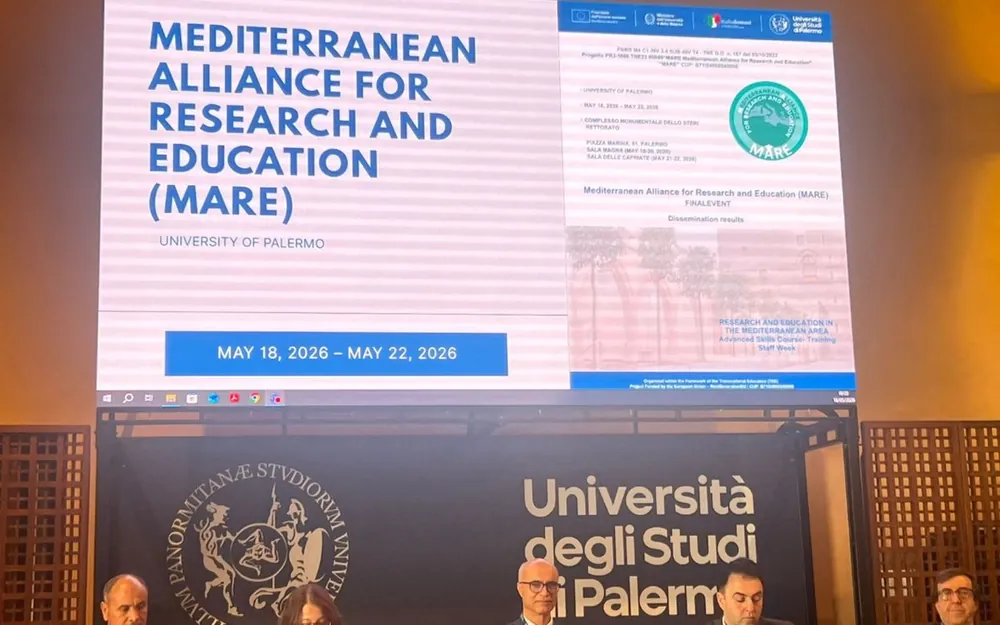
The UTM President co-opened the final assizes of the Mediterranean Alliance for Research and Education (MARE) at the University of Palermo. MARE brings together eleven Italian universities that aim to consolidate academic partnerships across the Mediterranean, especially with Tunisia, Morocco, Algeria and Mauritania. The universities of Tunis El Manar, Sfax and Kairouan took part, and the University of Carthage was announced for the closing ceremony, together with representatives of the Union for the Mediterranean and Tunisian, Algerian and Moroccan diplomats. The discussions covered ecological transition, renewable energies, the One Health approach and digital transition, and aimed at double degrees, joint master's programmes and international academic mobility.
For UTM, MARE operates under a cooperation agreement between the MARE consortium and the university, within a transnational education initiative funded by the Italian National Recovery and Resilience Plan. UTM published calls for mobility to the University of Pisa, among them a call for five teaching staff of the Faculty of Sciences of Tunis, ENIT, ISSBAT and the Veterinary Research Institute of Tunisia to teach for seven days in agriculture, food and agro-environmental sciences and engineering, as well as calls for the study mobility of students.
Final assizes of the Mediterranean Alliance for Research and Education (MARE), Palermo · Photo: official UTM Facebook page
HEALTHMED and Erasmus+ mobility with partner universities
UTM is a partner of the project HEALTHMED, “Innovation in medical education, digital transition, sustainable development and healthcare”. The project funds mobility for students of doctoral programmes, health specialisations and engineering fields, and for teachers and associates of the university, at the universities of Enna Kore, Messina and Magna Graecia of Catanzaro in Italy. A call announced four scholarships for study periods of two to three months and four teaching placements of seven days, and further calls followed.
UTM also published calls for funded student and staff mobility, mostly under Erasmus+, with universities in Italy (Palermo, Trento, Milan Polytechnic and Salerno), Spain (Granada and the Polytechnic University of Madrid), France (Rouen, Perpignan and Sorbonne Paris Nord), Norway (Bergen), Sweden (Uppsala), Estonia (Tallinn University of Technology), Greece (Aegean, West Attica and Western Macedonia), the Netherlands (Utrecht University of Applied Sciences), Belgium (Namur) and Portugal (Aveiro and the JAMIES programme). The call for the University of Salerno covers student mobility under Erasmus+ KA171 and teaching staff mobility.
Other schemes relayed to students and researchers include the agreement between the Ministry of Higher Education and Mitacs for final-year project internships in Canada, the master's scholarships of Wallonie-Bruxelles International, a mobility grant of the AICS-CDN consortium for study at the University of Pavia, and the summer programme of the Egypt-Japan University of Science and Technology (E-JUST), which offers an introduction to Egyptian culture and the Arabic language.
5th Turkish–Arab University Presidents’ Congress
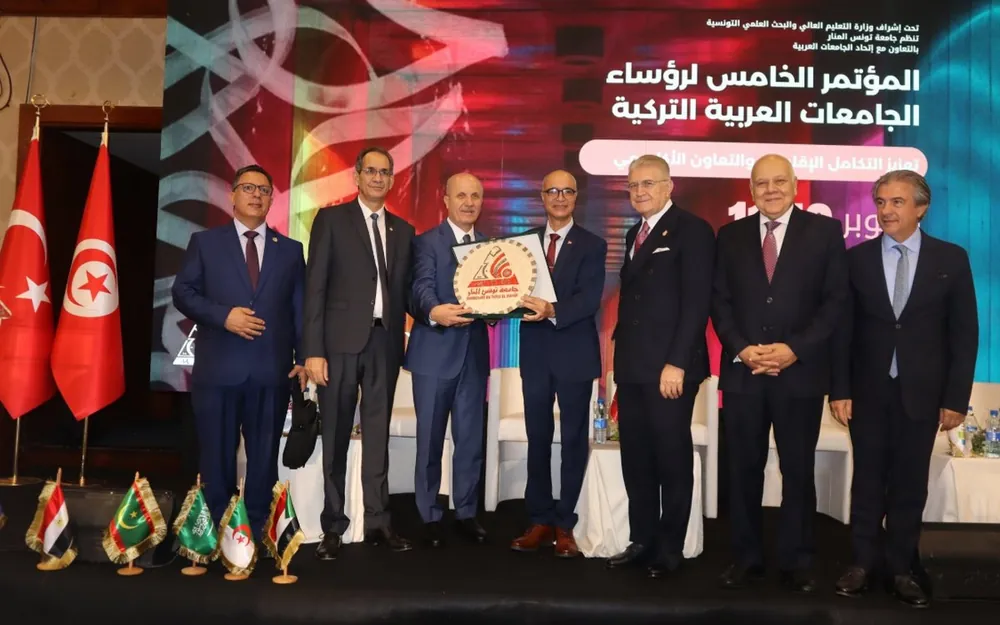
UTM organised the 5th Turkish–Arab University Presidents’ Congress at the Regency Hotel in Gammarth, with the Association of Arab Universities, the Turkish Council of Higher Education (YÖK), the Eurasian Universities Union and Istanbul Aydin University. A working meeting on the sidelines of the forum was chaired by the Tunisian Minister of Higher Education and Scientific Research, Mondher Belaïd, in the presence of the president of the Turkish Council of Higher Education, Erol Özvar, the Turkish Ambassador to Tunisia, Ahmet Misbah Demircan, and the president of the Union of Eurasian Universities, Mustafa Aydın.
The participants agreed to strengthen university and scientific cooperation between Tunisia and Turkey and called for a joint committee to follow and widen existing partnerships to universities and research centres. The priorities included joint research programmes, co-supervision of doctoral theses, co-publication, the mobility of students, teachers and researchers, and the mutual teaching of Arabic and Turkish, with Turkish students to be hosted at the Bourguiba Institute of Modern Languages. The priority fields were medicine, agriculture, information technology, languages and distance learning.
UTM also signed a framework cooperation agreement with Istanbul Aydin University, whose president is Prof. Mustafa Aydın, in the presence of the Turkish Ambassador. The agreement concerns sustainability initiatives and university branding, and the discussions covered scientific partnerships and the exchange of expertise in medicine, engineering, humanities, economics, languages and sustainable development strategies.
Cooperation with Oman: the Sohar forum and a memorandum of understanding
UTM took part in the forum of the Arab League Educational, Cultural and Scientific Organization (ALECSO) on the twinning of Arab universities, on the theme of the productive university. The forum was held at Sohar University in Oman and brought together universities from sixteen Arab countries.
UTM also signed a memorandum of understanding with the National University of Science and Technology of the Sultanate of Oman for a duration of five years. The presidents of the two universities, Prof. Moez Chafra and Ali Ben Massoud Al Baimani, signed it during an online meeting. The memorandum concerns scientific research, the exchange of expertise and the strengthening of training in the health, science and technology professions.
Arab regional bodies: student creativity council, admissions conference and Jordan
A delegation of the Arab Council for Student Training and Creativity, an academic body affiliated with the Association of Arab Universities, visited UTM to discuss the implementation of cooperation programmes that support student participation in academic and creative activities. The delegation was led by the director of the Council, Fawaz Ahmed Zaghoul, who presented a certificate of appreciation to the UTM President, Prof. Moez Chafra, as a board member representing Tunisian universities, and a certificate to Monia Najjar, UTM Vice-President for International Cooperation, as a member of the executive committee.
UTM and the University of Carthage organised, under the aegis of the Ministry of Higher Education, the 42nd annual conference of ARAB-ACRAO, the Arab organisation of officers in charge of admission and registration, in Hammamet. Experts from 18 countries discussed the role of admission and enrolment in improving the global ranking of universities along six axes: attracting talented students, digital transformation of administration, the links between academic quality and admission procedures, internationalisation, internal audit of processes and visibility in global rankings. It was the second time that Tunisia hosted this regional event.
The UTM President also received the Ambassador of Jordan to Tunisia, Dr Abdallah Abu Romman. They discussed the expansion of cooperation between universities of the two countries, the exchange of expertise in research and innovation and the setting up of joint programmes focused on the mobility of students and researchers, with the aim of offering new scientific training opportunities.
Intra-African research at Fort Hare and the Italy–Africa event in Bologna
UTM Vice-President for Research, Prof. Asma Gati, gave a keynote at the Research Week of the University of Fort Hare in South Africa on intra-African research. She presented the projects Intra-Africa BRAINS and AFRIDI and the Erasmus+ project DigIt Africa, which UTM coordinates. BRAINS (MoBility for Research and African Integration through Health Sciences) is funded by the European Union and offers fully funded Master's internships of ten months and doctoral research stays of one year at partner institutions abroad, in life sciences, health sciences, mathematics and computer science. UTM relayed its sixth call for applications and an online information session for students.
The UTM President took part in “Bridging Continents, Shaping Futures”, a cooperation event between Italy and Africa hosted by the University of Bologna. UTM's links with Italian universities also include the alliance MARE, the project HEALTHMED and the joint master's programme in migration studies with the University of Palermo.
Digital cooperation: DigItAfrica and the MENAFRICA Digital Summit
UTM coordinates the project DigItAfrica, “Fostering Digital Transformation in Africa by Building Digital Capability for All”, co-funded by the European Union. The project builds a competency-based approach that adapts existing digital transformation frameworks to African universities and proposes a strategy for university leaders built on eight actions: assess, encourage, train, facilitate, recognise, reward, share and evaluate. Its activities include online workshops, a study visit to a partner university and a mid-term consortium meeting hosted by UTM. UTM also announced a free, self-paced online programme on transversal non-technical digital skills, offered in French and English, together with training for educators who write content for the digital soft skills courses.
UTM organised the MENAFRICA Digital Summit at ENIT, a three-day platform that gathered representatives of ministries, universities, experts and actors of the public and private sectors to assess the state of digitalisation across sectors, share good practices and propose actions for an inclusive and sustainable digital transformation. Parallel training sessions covered advanced digital skills, artificial intelligence, inclusion and open education, large language models for software engineering, cybersecurity and data protection, blockchain and the metaverse.
First Tunisian–African forum on health system resilience
UTM organised the first Tunisian–African forum on resilience, risk and pandemic management and social justice in health, as part of the project African Health Security Indicator. The project involves the Brown University Pandemic Center in the United States and the Fondation Sciences pour l'Afrique, with the Ministry of Higher Education and Scientific Research and the Ministry of Health as co-organising partners. Institut Pasteur de Tunis, the Faculty of Medicine of Tunis and its laboratories and the Veterinary Research Institute of Tunisia took part, together with partners from South Africa, Kenya and the United Kingdom. According to the UTM President, the project was financed by the United States.
The project evaluated the preparedness of 64 African countries against health risks and epidemics, using indicators such as prevention, investment, climate-related resilience, hygiene and border protection, on the model of the Global Health Security Index. The project lead, Prof. Hanan Boussi of UTM, stated that Tunisia progressed on most indicators, especially investment in health, and that its weak points were communication mechanisms and the publication of research in English. The director general of international cooperation at the Ministry, Malek Kochlef, also spoke, and the forum discussed the spread of Ebola and the role of climate change in region-specific diseases. The results for each country are announced and ranked by indicator.
Delegations received from Africa, Asia, Europe and the Americas
UTM Vice-President Prof. Nesrine Zoghlami received a delegation of the High Council for Education of Benin, together with the deans and directors of the Faculty of Sciences of Tunis (FST), the Faculty of Economic Sciences and Management of Tunis (FSEGT), the National Engineering School of Tunis (ENIT), the Higher Institute of Medical Technologies of Tunis (ISTMT), the Higher School of Health Sciences and Techniques of Tunis, the Higher Institute of Computer Science (ISI), the Higher Institute of Nursing Sciences of Tunis (ISSIT) and the distance-learning office. UTM also welcomed a delegation of Gombe State University in Nigeria, led by Governor Muhammad Inuwa Yahaya.
UTM also welcomed a delegation of the Malaysian Ministry of Higher Education and Malaysian universities, the office of the Japan International Cooperation Agency in Tunisia, the engineering dean of Binghamton University in the United States and the Ambassador of Romania, Valentin-Ciprian Muntean, who was received by FSEGT and the Faculty of Law and Political Science of Tunis. The UTM President visited the Bourguiba Institute of Modern Languages (IBLV), where students of the University of Oxford learn Arabic, and IBLV signed a cooperation agreement with the Institut Supérieur des Langues de Nabeul.
Cooperation with Algerian institutions: Batna 2 University and the CRE of Annaba
UTM, through the Faculty of Sciences of Tunis, and Batna 2 University of Algeria held in Hammamet the 2nd International Conference on Innovative and Intelligent Information Technologies, with the IEEE IAS Tunisia chapter and the Ministry of Higher Education and Scientific Research. The two universities developed a shared strategic vision for scientific and digital cooperation. Their recommendations cover joint doctoral supervision, the exchange of teaching staff, the alignment of research programmes, a digital research platform giving Tunisian and Algerian researchers shared access to databases and local artificial-intelligence models, the conversion of innovative projects into start-ups, and applications in digital health, smart agriculture, renewable energy and cybersecurity.
UTM also signed a framework agreement with the Environment Research Centre (CRE) of Annaba in Algeria. The UTM President, Prof. Moez Chafra, and the president of the CRE, Zihad Bouslama, concluded it to boost academic cooperation and develop joint projects on current ecological challenges. UTM described it as part of its strategy to consolidate its regional and international position in priority areas such as ecological transition.
Tunisia–Algeria–Libya border hackathon on the circular economy
Initiated by UTM, the first Tunisia–Algeria–Libya border hackathon was launched at the International Centre for the Training of Trainers and Pedagogical Innovation under the slogan “Digital solutions for a circular economy”. Nine universities, three from each country, took part, and the Tunisian ones were Tunis El Manar, Sousse and Jendouba. About forty students and supervising teachers worked in teams of three students, one from each country, and one supervising teacher, designing software for the circular economy in line with the Sustainable Development Goals during workshops over two days, and the event closed with awards for the winners.
The hackathon aimed to strengthen ties and cooperation among students of the three countries, to lay the groundwork for collaborative work that reduces gaps between universities, and to rethink models of production and consumption in light of environmental challenges in the Maghreb, including resource management, sustainability and innovation. The organisers intend to hold further editions in the participating countries and to welcome new countries.
Closing of the DIRASA project
UTM, a consortium member of the Erasmus+ project DIRASA on the renewal of research governance in Tunisia, took part in its closing conference at the Cité de la Culture in Tunis, organised by the Ministry of Higher Education and Scientific Research. The morning opened with institutional addresses and a round table of beneficiaries from Tunisian universities, followed by a review of the project and a final video. Plenary sessions presented an international benchmarking of research and innovation governance, the training of administrative and academic staff through workshops in Tunisia, training weeks in Palermo and Djerba, study visits to Pavia, Pisa and Rouen and cascade training, as well as systems for strategic watch and performance steering and the creation of scientific interest groups and a national coordination network. A workshop with research and society stakeholders on the future of research in Tunisia was hosted at ENIT.
The conference ended with the presentation of a policy paper that summarises the lessons of the project and formulates strategic recommendations, together with an action plan to make the results last. A final partners' meeting followed, which reviewed the activities, indicators and deliverables, finalised the technical and financial reports and exchanged with the external evaluator on impacts. The partners stated that they are preparing new joint initiatives on research governance, socio-economic impact and integration in international networks.
MIGRANTS: joint master’s programme in migration studies
The MIGRANTS project created an international, interdisciplinary joint master's programme, “Migration Studies: Governance, Policies and Cultures”. It is coordinated by Tunisian universities (Tunis El Manar, Tunis and La Manouba) in partnership with the University of Palermo, the University of Westminster, the University of Granada, experts and NGOs, including organisations that work with refugees. The programme addresses the challenges of migration and refugees.
UTM published the call for applications to the joint master's programme. The programme offers a double degree with the University of Palermo, Erasmus+ mobility grants in Europe and, within the AICS-CDN consortium led by the University of Pavia, a limited number of scholarships for Tunisian and international students. Two books published within the project on migration studies, governance, policies and cultures were presented at an international workshop at the National Library of Tunisia, and UTM also announced the lists of pre-selected students and the results of mobility for students of the master's programme.
WE4LEAD: a Mediterranean consortium for women's leadership
WE4LEAD is an Erasmus+ capacity-building project co-led by Aix-Marseille University in France and the Lebanese University, with UTM and the University of Sousse in Tunisia, the universities of Constantine 3 and Mostaganem in Algeria, Antonine University in Lebanon, Sapienza University of Rome in Italy and the Autonomous University of Madrid in Spain as partners. The UTM team took part in coordination meetings at Aix-Marseille University and at Sapienza University of Rome, and the project concluded with a conference in Marseille.
UTM was represented by its President, Prof. Moez Chafra, and by the scientific coordinator of the project, Halima Ouanada, at the general assembly of the Téthys network at Aix-Marseille University, which gathered 120 participants from 22 universities in 11 countries. The network groups 87 universities from 21 Mediterranean countries, and its exchanges covered gender equality and adaptation to climate change. The UTM team also took part in the International Conference on Gender Studies at the Autonomous University of Madrid, on the theme “Gender and Leadership in Academia”: Halima Ouanada, Hajer Chaker and Nejiba El Yetim moderated a panel, presented a paper entitled “Widespread Presence, Limited Power: Women in Tunisian Higher Education and the Glass Ceiling” and joined a workshop on gendered data.
Agreements of Institut Pasteur de Tunis
Institut Pasteur de Tunis, an establishment of UTM, signed a partnership agreement with the Faculty of Sciences of Tunis. It also signed a collaboration and donation agreement with the Nishimura Foundation and a partnership agreement with INSA Toulouse.
As a member of the Pasteur Network, Institut Pasteur de Tunis was selected with two other members of the network to strengthen local capacity to produce mRNA vaccines. A strategic memorandum of understanding signed in Rio de Janeiro provides for cooperation in vaccine research and development, the sharing of knowledge and experience on mRNA technology, training programmes and joint projects.
Partnerships with Tunisian public institutions and universities
UTM signed a cooperation agreement with the General Directorate of Water Resources of the Ministry of Agriculture, Water Resources and Fisheries at a ceremony held at the Faculty of Sciences of Tunis. The ceremony announced the launch of a new scientific structure at the faculty, developed in partnership with the euro-Mediterranean project PRIMA SAVE Water. The agreement aims to use the results of scientific research and modern technologies for national water security and to turn the results of scientific projects into practical solutions for agriculture and the water resources sector, in view of water scarcity and climate change.
The Virtual University of Tunis (UVT) signed framework conventions with eleven Tunisian universities, among them Tunis El Manar. The conventions aim to strengthen academic and scientific cooperation, to develop joint innovative distance-learning programmes, to train teachers and supervisors in digital pedagogy, to pool resources, expertise and platforms, to encourage research and innovation, and to create digital teaching content suited to labour-market needs and continuing education.
A five-party consortium, the Project Management Office and Horizon Europe networks
UTM, the PUIT, the National Agency for the Promotion of Scientific Research (ANPR), the Caisse des Dépôts et Consignations, U-Accelerator and AICTO signed a consortium to support deeptech start-ups. UTM's Project Management Office announced several new competitive international projects, including three Erasmus+ projects and one Horizon Europe Marie Skłodowska-Curie Actions project.
EURAXESS Africa, Horizon Europe Tunisia and UTM organised an information day at FSEGT on mobility, networking and funding opportunities through EURAXESS and the MED and Africa initiatives of Horizon Europe, in order to strengthen euro-Mediterranean cooperation and to support young researchers in their participation in European programmes. UTM also relayed to students the START CUP competition of the Union of Mediterranean Universities (UNIMED), which encourages entrepreneurship and cooperation between universities on both shores of the Mediterranean.
Times Higher Education Sustainability Impact Ratings
UTM took part in the Times Higher Education Sustainability Impact Ratings and ranked first among Tunisian universities, in the 101-200 band, the same band as in the previous edition. The ratings assessed 1,646 universities from 116 countries on 17 indicators. Four other Tunisian universities were ranked: Sfax in the 601-800 band, La Manouba in the 801-1000 band, and Gabès and Tunis in the 1001-1500 band.
The assessment covers research related to the Sustainable Development Goals, governance and resource management, inclusive and sustainable teaching, environmental awareness, and cooperation with local, international and civil-society partners. The indicators include peace and justice as well as gender equality, poverty reduction, health and well-being and sustainable cities.
Agreements with civil-society and regional organisations for gender equality
UTM signed two cooperation agreements to support the research capacity of women, one with the Tunisian Women Mathematicians Association and one with the Tunisian Association for the Sustainable Development Goals. They were signed by the UTM President, Prof. Moez Chafra, and by the presidents of the two associations, Salma Negzaoui and Nejib Boulaares. The agreements aim to strengthen training, research, scientific publishing and conferences on mechanisms that support women's research capacity, and they are tied to the Sustainable Development Goals, especially SDG 5 on gender equality.
Within the project WE4LEAD, UTM also signed a convention with the Arab Women's Centre for Training and Research (CAWTAR), whose executive director is Soukaina Bouraoui. It launches cooperation in training, research and scientific publication and provides for conferences and seminars on gender-based violence, the green economy and sustainable development, and for the exchange of experience to strengthen women's research capacity.
A cooperation agreement was also signed with the ALECSO Chair for International Commercial Arbitration, represented by its director, Prof. Najet Brahmi. It aims to promote arbitration in the Arab world, with a particular focus on the place of women, and to disseminate and sustain the results of WE4LEAD. Senior officials of UTM, including the President and the Vice-President, and the WE4LEAD coordinators of the university attended the ceremonies.
Take the SDG 17 report with you
The 2026 report for SDG 17 is a 11-page brochure with every activity and photograph from this page.