Quality management, accountable governance, legal scholarship and international cooperation for peace shaped the contribution of the University of Tunis El Manar (UTM) to SDG 16. Its establishments obtained and renewed international quality certifications, students and teachers took part in university councils, and the Faculty of Law and Political Science of Tunis hosted colloquia and signed research agreements. UTM also joined university presidents in Hiroshima and took part in projects on research governance and gender equality in leadership.
ISO 9001:2015 quality management certification renewed
The University of Tunis El Manar (UTM) renewed its certificate of conformity to the ISO 9001:2015 quality management standard after an external evaluation committee approved the renewal. The decision followed internal and external audits that covered all university services and checked compliance with current procedures and the effectiveness of the quality management system. UTM announced the renewal in a press communiqué and thanked the quality team, the administrative and technical managers and all the staff who contributed to maintaining the certification.
The renewal was prepared in several steps. A follow-up meeting on the certification brought together the people in charge of the quality management system, and an internal audit for the renewal was then carried out over two days, ahead of the external assessment. Because the audits covered all services, the certification concerns the administrative procedures of the university as a whole.
ISO 21001:2018 certification of ISTMT, ISSIT, FSEGT and FDSPT
The Higher Institute of Medical Technologies of Tunis (ISTMT) obtained certification to ISO 21001:2018, the international standard for management systems of educational and training organisations. The certificate was granted after an audit carried out in two phases. It covers academic training, scientific research and student supervision in medical technologies under the LMD system, together with engineering training in eight specialities, among them biomedical engineering, medical biotechnology, medical imaging, biophysics and radiophysics, health management and industries, and hearing devices. UTM announced the result in a press release.
The Higher Institute of Nursing Sciences of Tunis (ISSIT) also obtained the ISO 21001:2018 certification, and UTM congratulated the institute and its team and published the certificate. The Faculty of Economic Sciences and Management of Tunis (FSEGT) renewed the certification it holds under the same standard. Other establishments have started similar steps: the Higher Institute of Human Sciences of Tunis (ISSHT) launched the selection of a body to set up a management system for educational organisations under ISO 21001, and ISTMT launched a consultation for an audit leading to a corporate social responsibility certification.
The Faculty of Law and Political Science of Tunis (FDSPT) obtained a certificate of conformity to ISO 21001:2018 once its external audit was completed. UTM stated in a communiqué that the distinction reflects the faculty's commitment to applying international quality standards in its training and management.
Student and staff representation in university councils
UTM organised the election of student representatives to the University Council. The calendar published by the university set out each step of the procedure: two days for filing candidacies at the candidate's own establishment, the display of the list of candidates, a window for withdrawals, a day of electoral campaign and a single day of voting at the university headquarters. The vote concerned the student seats on the Council, the university body in which students are represented.
Teaching staff are also represented. UTM published the list of the representatives of the pedagogical staff on the scientific councils of its establishments, who serve a mandate of three years. Together, the two procedures give students and teachers a formal voice in the governance of the university and of each faculty, school and institute.
Listening and support cell for students
UTM launched a pilot cell for listening to and supporting students. The cell was set up by the University Council and belongs to an international project involving institutions abroad, notably in France, Italy, Lebanon and Algeria. The UTM President, Prof. Moez Chafra, presented it on national radio. It brings together university psychologists, psychiatrists who teach at the Faculty of Medicine of Tunis and teachers of the psychology department of the Higher Institute of Human Sciences of Tunis.
The cell collects students' accounts, examines their difficulties, guides them towards suitable solutions and follows them so that they can continue their year and their course. The situations it addresses include psychological difficulties, different forms of violence, among them verbal violence, racism and gender-based discrimination. Students have priority, and teachers, administrative staff and other employees of the university can also use the service. The President stressed that exchanges remain confidential and that the aim is to give students the conditions to succeed.
Integrity, transparency and complaint mechanisms
UTM maintains a policy on organised crime, corruption and fraud. It commits the university to combat bribery, extortion, influence peddling, nepotism, fraud and embezzlement, with reference to the national higher education law. Under the policy, teaching and administrative staff respect the codes of practice on ethical conduct, any pecuniary interest is declared and conflicts of interest are avoided, terms of reference and standard operating procedures are established for the major committees, and committee decisions are recorded in minutes and made available to staff and students.
The university's financial transparency policy provides for an annual financial report on the government budget, other funding sources and expenditure, shared with the authorities and made available to stakeholders, and for regular internal and external audits. A policy on academic freedom and freedom of expression states that staff and students can debate and exchange ideas freely and that academics choose their own teaching and research methods, while a stakeholder engagement policy identifies the public, the press, students, graduates, staff, government, NGOs and private organisations as partners to be consulted.
Two committees complete this framework: an ethics committee made up of university leaders and professors from several establishments, and a mediation and conflict-management committee with members from the Higher Institute of Human Sciences of Tunis, the Higher Institute of Medical Technologies of Tunis, the Faculty of Sciences of Tunis and the central services. The university website also offers a complaint form, a page on access to information and an anti-plagiarism system for research.
DIRASA: modernising research governance in Tunisia
DIRASA is an Erasmus+ capacity-building project, in the strand of structural reform, that aims to strengthen the governance of university research in Tunisia. It is coordinated by the University of Sfax and brings together the thirteen public universities, including UTM, the Ministry of Higher Education and Scientific Research, the National Agency for the Promotion of Scientific Research and, from Europe, the universities of Pisa, Pavia and Rouen Normandie, the Union of Mediterranean Universities and CESIE. Its objectives are better foresight, national coordination, internal governance and quality assurance, and wider visibility of research.
The project produced a benchmarking report on research governance prepared by the universities of Monastir and Rouen Normandie, which UTM announced on its website. Three further deliverables concern accountability and steering: an institutional action plan for each partner university on strategic watch and performance cells, a performance contract model defining the reciprocal commitments of the ministry, universities and research structures with results-based funding and evaluation indicators, and a roadmap for the transition of universities to the status of public scientific and technological establishment, including management control and internal control functions. The closing conference also presented a policy paper with strategic recommendations for Tunisian research.
WE4LEAD: equality mechanisms for inclusive governance
UTM addresses gender equality in decision-making through the Erasmus+ capacity-building project WE4LEAD (Women's Empowerment for Leadership and Equity in Higher Education Institutions). The project aims to increase women's access to the highest decision-making posts and so to contribute to fully inclusive governance and management of higher education institutions. It is carried out by a consortium of nine universities from the Mediterranean region and was funded for a duration of 36 months.
Within the project UTM designated an ambassador for Sustainable Development Goal 5, Halima Ouanada, who is also the academic coordinator of WE4LEAD at the university, created a Cell for Parity and Respect and adopted a women-men equality plan. UTM links these mechanisms to its 14th place worldwide for SDG 5 in the Times Higher Education ranking. At the coordination meeting held at Sapienza University of Rome, the partners worked on the collection of gendered data, awareness tools, equality plans and listening cells dedicated to the fight against harassment.
Agreement with Hiroshima University
UTM President Prof. Moez Chafra took part in the 5th International Conference of University Presidents for Peace, Arab Chapter, hosted by Hiroshima University in cooperation with the Association of Arab Universities. More than twenty presidents and representatives of universities and institutions from six countries attended. Participants presented the peace and sustainability initiatives of their campuses and discussed future collaboration with Hiroshima University, and the Declaration of the University Presidents for Peace was read at the close of the session.
UTM signed a cooperation agreement with Hiroshima University during the conference, initialled by the UTM President. The academic and scientific agreement covers joint research, student exchanges, co-supervision of doctoral theses, joint scientific events and mobility of teacher-researchers. At the same conference Hiroshima University and the Association of Arab Universities signed a partnership agreement that the Japanese university described as the first of its kind in Japan.
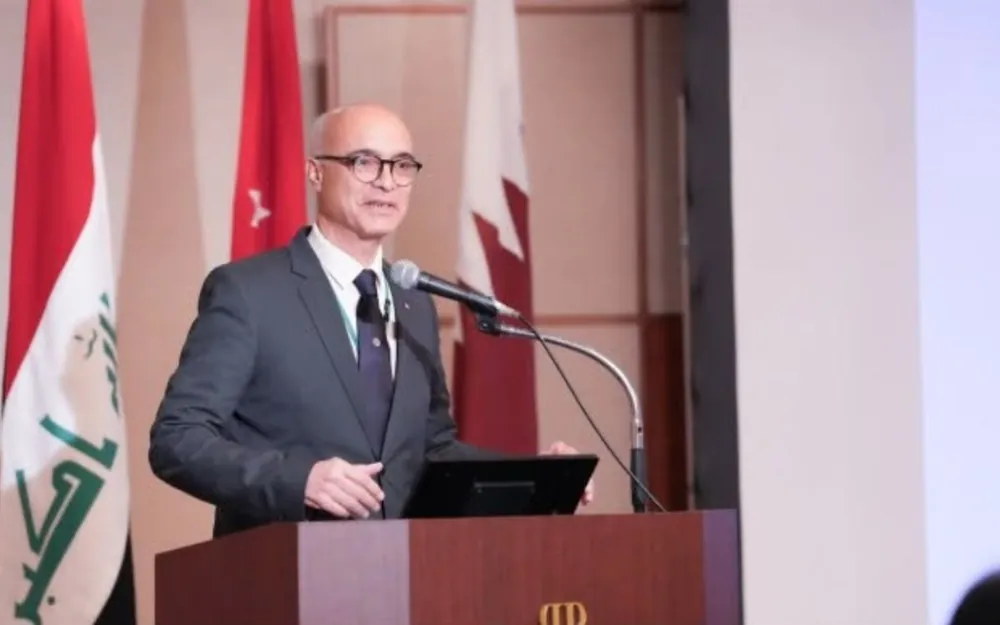
The UTM President at the 5th International Conference of University Presidents for Peace, Hiroshima · Photo: official UTM Facebook page
Intercultural dialogue: language teaching at IBLV and the Phare des Cultures day
The Bourguiba Institute of Modern Languages (IBLV), an establishment of UTM, presents language teaching as a way to build intercultural understanding and tolerance. It hosted the Japanese-Language Proficiency Test in partnership with the Japan Foundation, and it runs, with the Office of Tunisians Abroad, a programme of Arabic teaching for the children of Tunisians living abroad. The Office covers 70 percent of tuition, accommodation and insurance costs, and families pre-register on the website of the institute.
The institute also appears in the conclusions of the forum of Arab and Turkish university presidents, which provided for Turkish students to be hosted at IBLV to learn Arabic. In relations with Japan, a former director of the institute, Prof. Imed Ben Ammar, received the Japanese Order of the Rising Sun, Gold Rays with Rosette, for his contribution to the teaching of Japanese at the institute and to cultural cooperation between the university and Japanese counterparts.
UTM Phare des Cultures reached its third edition. The university invited students to a day at the stadium of the Farhat Hached El Manar university campus to celebrate the diversity of its international student community, with gastronomy, shows, cultural stands and encounters under the motto of unity in diversity.
ALECSO Chair for International Commercial Arbitration: forum, recognition and annual days
The ALECSO Chair for International Commercial Arbitration, directed by Prof. Najet Brahmi and hosted by UTM and the Faculty of Law and Political Science of Tunis (FDSPT), organised with the Arab League Educational, Cultural and Scientific Organization (ALECSO) an international forum on arbitration, mediation, alternative dispute resolution, corporate social responsibility and duty of care. The forum took place at the ALECSO headquarters in Tunis and gathered academics and experts from Tunisia and Europe. A training programme in international commercial arbitration, announced during the forum, followed it with trainees from Algeria and Tunisia.
The UNESCO Regional Bureau in Beirut honoured the Chair as one of the best Arab experiences among the scientific chairs affiliated with ALECSO, citing its contribution to strengthening academic and professional capacities in the Arab region after nearly four years of activity.
The fourth edition of the days of the Chair, on the theme Arbitration, Innovation, Excellence, was held at the ALECSO headquarters with closing activities at the faculty. It included the presentation of the third issue of the Arab Journal of ALECSO Chairs, publications on corporate social and environmental responsibility and an English-language moot court competition. The recommendations called for extending the moot court to students from Arab countries, helping outstanding students to join moot court competitions in Paris and Stockholm and creating a Chair award for the best written pleading.
New ALECSO Chair on dispute resolution and digitalisation
ALECSO announced the launch of the ALECSO Chair for Dispute Resolution and Digitalisation during a symposium on digital justice in the age of artificial intelligence, held under the theme Artificial Intelligence and the Reshaping of the Functions of Justice. The chair holder is Dr Hatem Rouatbi, head of the dispute resolution laboratory of the Faculty of Law and Political Science of Tunis. The Chair supports research on the effects of digital transformation and emerging technologies, especially artificial intelligence, on justice systems and dispute resolution.
Dr Mohamed Jemni, director of ICT at ALECSO, spoke on generative artificial intelligence and AI agents in digital justice. Dr Amal Essid, associate professor of private law and criminology, presented artificial intelligence as a tool for civil and criminal justice, and Judge Amani Amdouni of the Court of First Instance of Tunis discussed judicial efficiency and fair trial guarantees. The address of the ALECSO Director-General called for using these technologies within well-regulated legal and institutional frameworks that preserve fair trial guarantees and judicial independence.
11th colloquium “Readings in judicial case-law”
The laboratory of legisprudence and jurisprudence of the Faculty of Law and Political Science of Tunis held the 11th national colloquium “Readings in judicial case-law”, with the participation of the National Bar. The UTM President, Prof. Moez Chafra, gave the opening address and described scientific research as a fundamental pillar of university action, calling for the university to open up to its socio-economic environment. The Bâtonnier of the National Bar Association of Tunisia, professors and legal practitioners attended.
The sessions dealt with legal qualification and the extraction of the meaning of texts, and with the way courts, notably the Court of Cassation, interpret legal texts. Case studies included decisions taken during the pandemic and disputes over financial transactions and compensation. The colloquium aimed to bring academic analysis together with practical expertise, to strengthen the research culture and to develop the skills of students and researchers.
Criminal justice debates: Article 96 and the presumption of innocence
The Faculty of Law and Political Science of Tunis (FDSPT) held a round table on Article 96 of the Penal Code. The discussion dealt with the public and civil actions linked to the offence of misconduct by public officials, a provision that concerns the responsibility of those who hold public office.
The Research Unit in Criminal Sciences and Criminology of the faculty, with Université Centrale as partner, organised an international colloquium entitled “Principe d'innocence, principe fondateur”. The unit's president, Fadoua Kahouaji, gave the opening address, and speakers included Evelyne Bonis, associate professor at the University of Bordeaux and director of its Institute of Criminal Sciences and Justice, the lawyer and academic Kamel Ben Messaoud, and Rachida Jelassi, professor of criminology, by videoconference. The debates covered the presumption of innocence as a guarantee of individual rights in Tunisian and international law, violations of the principle through criminal procedure itself and through online accusations presented as established facts, protection against coercive judicial power, compensation for reputational harm and the reasonable length of criminal proceedings.
International colloquium on tax cooperation and tax evasion
The Laboratory of Constitutional, Administrative and Financial Sciences of the Faculty of Law and Political Science of Tunis was the academic partner of the Observatoire tunisien de l'économie in an international colloquium on international tax cooperation in the light of the new international tax order. The programme brought together academics, experts, practitioners and civil-society representatives.
The first day examined the new international tax order, including the respective roles of the OECD and the United Nations and the prospects of tax reform for North African countries. The second day addressed tax evasion, the digital economy and the financing of equitable development, with panels on adapting international tax law standards, digital taxation, dispute resolution and the link between bilateral tax treaties and development goals.
Cooperation with IRZ on access to justice and legislative drafting
The Research Centre for Dispute Resolution and Enforcement Methods of the Faculty of Law and Political Science of Tunis (RELEVE) is a partner of the German Foundation for International Legal Cooperation (IRZ) in a project on access to justice and the protection of vulnerable groups, funded by the German Embassy in Tunisia. The project has three components: strengthening the access of vulnerable groups to justice, promoting legal aid during proceedings, and supporting people after proceedings in securing their rights and enforcing judgments. Other partners include the National Bar of Tunisia, the German Federal Bar Association and civil-society organisations.
In the field of legislation, RELEVE and IRZ co-drafted and edited a manual on quality standards for legislative drafting, and a legislative drafting guide was presented at a conference on promoting quality in legislative drafting. The faculty also offers a master's programme in legislative drafting, developed with the Presidency of the Government and supervised under the guidance of Dr Rabha Ghandri, a specialist in legislative drafting who holds IRZ certifications as a trainer in legislative drafting and in supporting vulnerable people's access to justice.
IRZ also organised in Tunis a two-day conference on the reform of banking law, with the Faculty of Law of Tunis, the Tunisian Bar Association and the Chamber of Notaries as cooperation partners. About forty justice stakeholders, among them judges, bailiffs, notaries and representatives of the central bank, discussed the practical application of the reform that decriminalises uncovered cheques and provides for alternative sanctions, with a German specialist in banking and capital market law explaining the German rules on cheques.
Revue tunisienne de droit des affaires, first issue
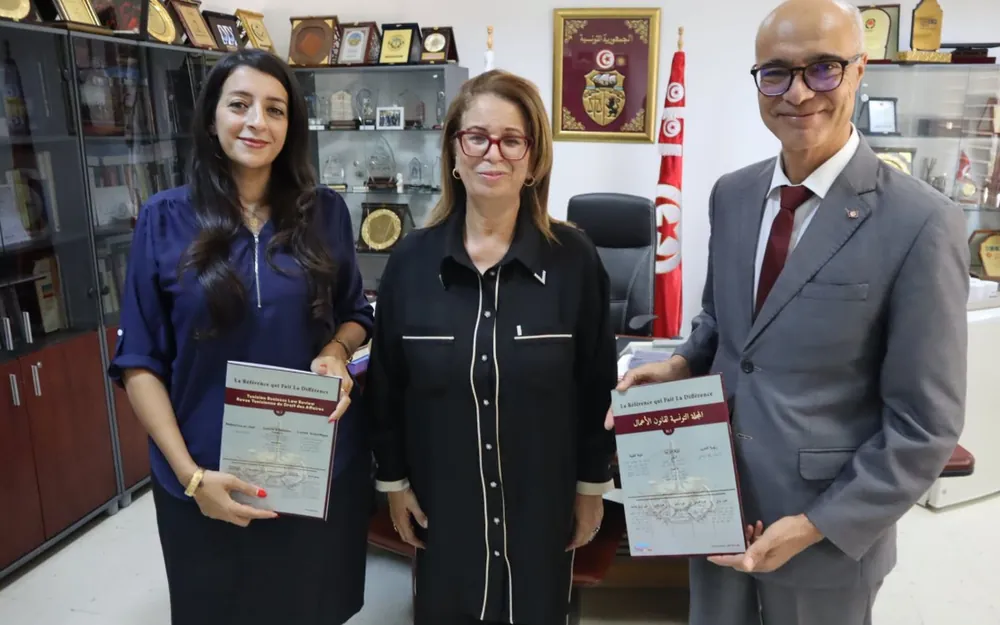
The Faculty of Law and Political Science of Tunis (FDSPT) published the first issue of the Revue tunisienne de droit des affaires, a journal devoted to business law. Its editor-in-chief is Prof. Najet Brahmi, who also directs the ALECSO Chair for International Commercial Arbitration, and its honorary board is chaired by the president of the Bar, Boubaker Bethabet.
The laboratory of legisprudence and jurisprudence of the Faculty of Law and Political Science of Tunis signed a partnership agreement with the Conseil du Marché Financier (CMF), the financial market regulator, in the presence of UTM President Prof. Moez Chafra and Dean Prof. Mustapha Ben Letaief. The agreement aims to strengthen scientific and technical cooperation and gives an institutional framework to joint studies, seminars, conferences and study days, applied research projects, training and the exchange of expertise.
Academic work under the agreement covers financial transparency, investor protection, risk management, financial innovation and sustainable finance. The agreement also provides for projects to compile and publicise the case law of the CMF so that it becomes easier to access and understand, and it gives researchers, doctoral students and students access to the professional expertise of the CMF in market regulation and supervision. The CMF presented the agreement as a step towards opening up to the academic environment and working more closely with universities.
Take the SDG 16 report with you
The 2026 report for SDG 16 is a 9-page brochure with every activity and photograph from this page.