The University of Tunis El Manar (UTM) contributes to SDG 15, Life on Land, through campus tree planting, research and teaching on biodiversity, plants and soils, and cooperation with environmental research centres in Tunisia and abroad. The Faculty of Sciences of Tunis (FST), the Higher Institute of Applied Biological Sciences of Tunis (ISSBAT) and the Faculty of Economic Sciences and Management of Tunis (FSEGT) carry much of this work, and the goal is coordinated by its professor ambassador, Prof. Atef Jaouani.
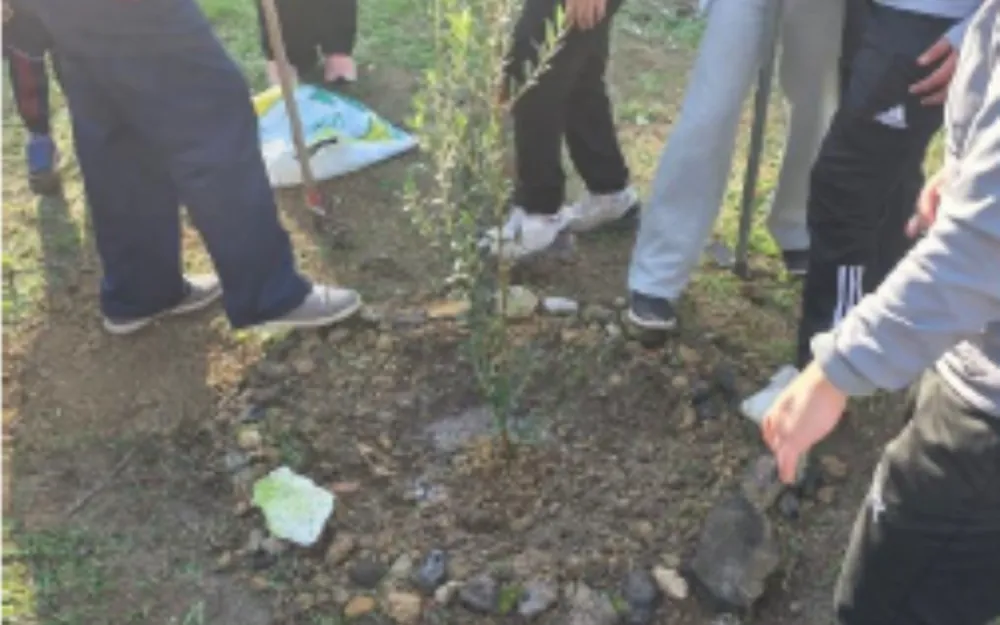
The Faculty of Sciences of Tunis (FST) held the event “Sport, environment and citizenship”, which combined sports activities with the planting of olive trees on the campus. Students first took part in interactive sports meant to build cooperation and then planted olive trees, presented as a living symbol of urban greening and of a tangible connection to the land. The faculty described the action as an example of how young people can help to build greener and more sustainable communities.
Students planting olive trees at FST · Photo: UTM SHINE
Cooperation with the Environment Research Centre of Annaba
The President of UTM, Prof. Moez Chafra, received Prof. Zihad Bouslama, director of the Environment Research Centre (CRE) of Annaba, Algeria, and the two institutions agreed a framework agreement on environmental cooperation. The agreement is meant to strengthen academic cooperation and to develop joint projects that respond to pressing ecological challenges, within the strategy of UTM to consolidate its regional and international position in fields linked to the ecological transition.
According to the press report, both sides stressed the need to pool their efforts and exchange expertise, to promote the results of scientific research and to reinforce the mechanisms of academic cooperation, in order to consolidate Tunisian–Algerian collaboration in the environmental field. No specific joint project was named when the agreement was signed.
The CRE is a public institution of a scientific and technological character. It organises its research in four divisions: environment and biodiversity; environment and health; environment, modelling and climate change; and environmental innovation and eco-management of waste.
Lagoon ecosystems of Bizerte and Ichkeul
An international seminar organised by the LEDDRNA laboratory of FSEGT within the GEL GINTEL Bizerte project devoted its first session to the Bizerte lagoon and Lake Ichkeul, two connected ecosystems of northern Tunisia. Lake Ichkeul is a wetland of international importance, designated as a Ramsar site and a UNESCO Man and the Biosphere reserve, and the Lake of Bizerte, linked both to the Ichkeul and to the Mediterranean Sea, is considered a pollution hotspot.
The session was moderated by Prof. Béchir Bejaoui of the National Institute of Marine Sciences and Technologies and brought together Prof. Lamia Mokaddem, director of the LEDDRNA laboratory, and Prof. Abdessalem Shili of the National Agronomic Institute of Tunisia. The project behind the seminar aims to build scientifically validated solutions to the social, economic and environmental problems caused by the degradation of the lagoon.
Seminar on institutional frameworks and financing for wetland conservation
The LEDDRNA laboratory of FSEGT organised a seminar entitled “Institutional Framework and Financing Mechanisms for Wetland Conservation in Tunisia”, in collaboration with the Ministry of Environment, the Ministry of Agriculture, Water Resources and Fisheries, the United Nations Development Programme (UNDP) and the ATRIADD association. The seminar was part of the GEL GINTEL Bizerte project, under the programme for the depollution of the Lake of Bizerte launched by the National Agency for Environmental Protection and co-financed by the European Union.
Its main objective was to examine how the institutional framework and the financing mechanisms that support wetland conservation in Tunisia can be strengthened. The director of the laboratory, Prof. Lamia Mokaddem, also heads ATRIADD, the Tunisian Association of Research, Innovation and Action for Sustainable Development.
StopUP: nature-based solutions against urban runoff pollution at ISSBAT
The Higher Institute of Applied Biological Sciences of Tunis (ISSBAT) takes part in StopUP, the Horizon Europe project “Protecting the aquatic environment from urban runoff pollution”, whose main objective is to propose natural and innovative solutions that limit the impact of diffuse urban pollution, notably from runoff water in urban areas. ISSBAT called for a research assistant on a seven-month contract to manage equipment, consumables and technical documentation and to help prepare the progress reports and deliverables of the project. The call is signed by Prof. Atef Jaouani as coordinator of the StopUP project and by the director of the institute.
A later call, for a six-month post-doctoral researcher paid from the remaining funds of the project, restates the main objective as increasing the efficiency of water use, improving water quality and replenishing groundwater resources. The post requires skills in environmental bioprocesses based on nature-based solutions, in the microbiological analysis of microbial communities and in the physico-chemical analysis of pollutants, and its tasks include operating a pilot water treatment system, writing scientific publications and organising scientific events.
UTM also reports a partnership agreement between ISSBAT and Vivo Energy Tunisia, signed at a service station in Tunis in the presence of the President of UTM, which focuses first on StopUP. A pilot treatment unit for overflow and runoff water is planned at the station, near Sabkhet Sejoumi, as a demonstration site for nature-based technologies adapted to the Tunisian environment.
Biodiversity and climate resilience workshops in Jordan with GDA Sidi Amor
In partnership with the Groupement de Développement Agricole Sidi Amor, UTM took part in two workshops in Jordan: “Strengthening Biodiversity Resilience in a Changing Climate”, held at the Azraq Eco-Lodge, and “Biodiversity – Nature’s Blueprint for Climate Adaptation”, held at the Royal Academy for Nature Conservation in the Ajloun Forest Reserve. Prof. Atef Jaouani presented the initiatives led by the Groupement alongside the research contributions of UTM to biodiversity conservation and climate adaptation.
The sessions highlighted approaches to strengthen ecosystem resilience, promote sustainable land management and address biodiversity challenges caused by climate change. UTM lists the Sidi Amor group among its sustainability partner centres, as a research and development centre on sustainable agricultural practices and rural development that offers students and researchers a collaborative setting to explore agricultural technologies.
UTM also reports a collaboration with the Sidi Amor group and partners in Germany within the Taaziz programme, which aims to promote environmental conservation and sustainable tourism through practices such as waste reduction, energy efficiency and water conservation in tourism resorts.
Scientific day on soil biofertilisers and climate change at FST
The Faculty of Sciences of Tunis (FST) organised a scientific day on soil biofertilisers in the context of climate change, under the theme “Towards Resilient Agriculture: Biofertilizers and Sustainable Strategies in Response to Climate Change”. It was held with the Horticultural Sciences Laboratory of the National Agronomic Institute of Tunisia (INAT) as part of the scientific programme of the faculty, and it was open to students, farmers and the general public.
The programme combined public conferences with interactive workshops for students. It addressed the adaptation of biofertiliser use to different soil types, the efficient use of irrigation water and the improvement of agricultural productivity under changing climatic conditions, and it presented biofertilisers as an ecological strategy for sustainable and resilient agriculture.
Campus greening, biodiversity zones and tree planting
The sustainability policy of UTM describes the greening of the campus of El Manar with the support of the Council of El Manar City. Campus redesigns integrate native plants that need little water, such as olive and almond trees, and biodiversity zones maintained by student clubs support local wildlife. Tree-planting events co-hosted with the council are presented as a contribution to regional carbon offsetting.
The pollution reduction policy adds the creation of green areas on campus to act as natural air filters. A green campus and open leisure space project presented on the same platform, led by Prof. Noamen Rebai of the National Engineering School of Tunis (ENIT) with the ATG association, proposes a sustainable and eco-friendly complex that would create green areas to improve air quality and well-being.
UTM’s list of sustainability projects also includes UTM GREEN, which supports the climate strategy and the net-zero action plan in collaboration with researchers, governmental organisations and NGOs, and a tree-planting initiative for reforestation and greener spaces in Tunisia that aims to promote ecological balance and combat desertification.
Biodiversity policy: rare species, habitat restoration and invasive species on campus
The biodiversity policy for the campus of UTM aims to preserve local terrestrial and aquatic ecosystems and to protect the rare and endangered species identified in them. It provides for studies to identify threatened species on campus and in surrounding ecosystems, regular monitoring of populations and threats, and the restoration of terrestrial habitats through sustainable practices such as permaculture, together with protected areas on campus to foster natural regeneration.
The policy also commits UTM to monitor and control invasive species that threaten terrestrial and aquatic biodiversity, to restore degraded ecosystems so that native species can recover, to follow European Union guidelines and the Red Lists of the International Union for Conservation of Nature (IUCN), to raise awareness of red-listed species within the university community and to integrate the conservation of endangered species into curricula. For implementation, the policy foresees key indicators to measure progress, partnerships with the IUCN, fisheries management bodies and international conservation programmes, and the involvement of students, staff and local stakeholders in species protection initiatives.
Research themes on land ecosystems: animals, plants and microorganisms
UTM’s report on this goal describes research on terrestrial biodiversity along three lines. Animal-focused studies address the documentation of species, the restoration of habitats and the reduction of ecosystem degradation caused by deforestation, urbanisation, hunting and pollution, as well as by climatic events such as desertification and flooding.
Plant research examines resilience to environmental stress, including water scarcity and soil salinity, and the use of saline or treated wastewater for irrigation, with the aim of proposing viable models for sustainable agriculture. Microbial studies stress the ecological importance of microorganisms in maintaining the balance of ecosystems and in sustainable resource management.
Research laboratories on biodiversity, plants, soils and climate
The research structures of FST include several laboratories working directly on terrestrial ecosystems: Biodiversity, Biotechnology and Climate Change, headed by Sondess Stambouli; Plant Productivity and Environmental Constraints, headed by Chiraz Chaffei Haouari; Diversity, Management and Conservation of Biological Systems, headed by Karima Nasri Ammar; and Interactions between Plants, Soil and the Environment, headed by Hela Ben Ahmed.
The laboratory of Mycology, Pathologies and Biomarkers at FST and the laboratory of Bioresources, Environment and Biotechnology at ISSBAT, headed by Khaled Sebei, complete this research base, which feeds the teaching programmes and the field activities described under this goal.
Teaching programmes in biology, ecology and bioresources
The Department of Biological Sciences of FST, led by Pr. Imene Ouzari, offers a licence in life and environmental sciences with a track in the management and valorisation of bioresources, a licence in life sciences with a track in the biology of organisms and populations, and research, professional and international master’s programmes, among them master’s programmes in evolutionary ecology, plant productivity and aquatic ecosystem biology. Its research areas include animal ecology, plant biology and physiology, and microbiology.
Doctoral training in biological and earth sciences is organised by the doctoral school of life and earth science and technology, which FST manages with partner institutions including the Institut Pasteur de Tunis, the Faculty of Medicine of Tunis and ISSBAT. At ISSBAT, the licence in biotechnology offers a plant biotechnology specialty, the licence in life and environmental sciences offers bioresources management and valorisation and waste treatment and valorisation, and master’s programmes cover quality, environment and safety and life and environmental technologies. The institute also opened further application sessions for its professional master’s in environmental engineering.
Teaching programmes in earth sciences, soils, water and geomatics
The Geology Department of FST, directed by Dr. Sami Riahi, offers a three-year licence in earth sciences, with a track in georesources and environment, and a licence in geomatics with tracks in geomatics applied to earth sciences and to urban and territorial planning. Its research master’s programmes include applied environmental geology, georesources and sustainable development, hydrogeology and geotechnics, and integrated water and sustainable agriculture management; its engineering degree in geosciences has a water track, and a professional master’s in geomatics offers tracks in GIS and remote sensing and in surveying and territorial projects. The department lists soil science, environmental geology, hydrogeology, hydrology and geomorphology among its disciplines.
Field study visits to natural sites and species conservatories
Faculty members, including Dr. Sonia Hmaied, and students of FST and of the Higher Institute of Medical Technologies of Tunis (ISTMT) took part in study visits to natural sites and species conservatories. These field experiences are part of the biodiversity courses and research activities and give participants practical, hands-on knowledge of conservation practices.
Plant biotechnology students visit a plant nursery in Nabeul
Third-year Plant Biotechnology students of ISSBAT visited the El Baraka nursery in Bir Drassen, in the north of the Nabeul governorate, as an immersion in the field within the job-oriented training of the institute. They learned to recognise the species and categories of ornamental plants, including palms, succulents and cacti, flowering trees and shrubs, grasses and annual herbaceous plants, and studied the propagation techniques used in a nursery.
Student clubs, tree planting and biodiversity training
The sustainable development clubs of UTM, active at FST, ENIT, the Faculty of Medicine of Tunis and the Higher Institute of Nursing Sciences, organise conferences, debates and exhibitions and offer workshops on topics that include agriculture, forestry and biodiversity protection. The clubs also take part in concrete projects such as tree planting, waste sorting and energy-saving initiatives.
Student projects on beekeeping and soilless cultivation
UTM’s report on zero hunger describes B-CONNECT, a platform that helps beekeepers find the best places for their hives and adds security features against hive theft, as a contribution to the protection of bee populations and to biodiversity. The same report describes SOUAQI, a hydroponic project initiated by three doctoral students in biology who are hydroponics trainers, in collaboration with Enactus ENIT, which promotes soilless cultivation to cut water use by 90 percent and to avoid pesticides. SOUAQI built a distribution network for unprocessed organic agricultural products, trained enthusiasts and aspiring agripreneurs in hydroponics, and launched nine hydroponic projects across Tunisia.
GreENIT and LABEL ENIT: days for trees and a clean campus
The National Engineering School of Tunis (ENIT) organises GreENIT, an event that highlights the ecological importance of trees and green spaces, together with LABEL ENIT, a day devoted to the aesthetics and cleanliness of the school and its surroundings. UTM presents both events as part of the environmental education of the ENIT community.
Partnerships with environmental associations
The list of main sustainability partners and NGOs of UTM includes associations active in nature protection and land conservation: the Tunisian association for the protection of nature and the environment (ATPNE), the association for the protection of nature and the environment of Kairouan (APNEK), Les Amis des Oiseaux (BirdLife in Tunisia), the Tunisian wildlife association, the African section of the international network of NGOs on desertification (RIOD), the association network for the sustainable development of oases (RADDO), the Tunisian soil science association and the Mediterranean NGO network MED Forum.
Take the SDG 15 report with you
The 2026 report for SDG 15 is a 8-page brochure with every activity and photograph from this page.