The University of Tunis El Manar (UTM) contributes to SDG 14, Life Below Water, through research, training and policy work on the lagoons and coasts of northern Tunisia. The Faculty of Economic Sciences and Management of Tunis (FSEGT) leads the GEL GINTEL Bizerte project on the governance of the Bizerte lagoon, while the Faculty of Sciences of Tunis (FST) and the Higher Institute of Applied Biological Sciences of Tunis (ISSBAT) study sediments, microplastics and aquaculture. The goal is coordinated by its professor ambassador, Prof. Moncef Gueddari.
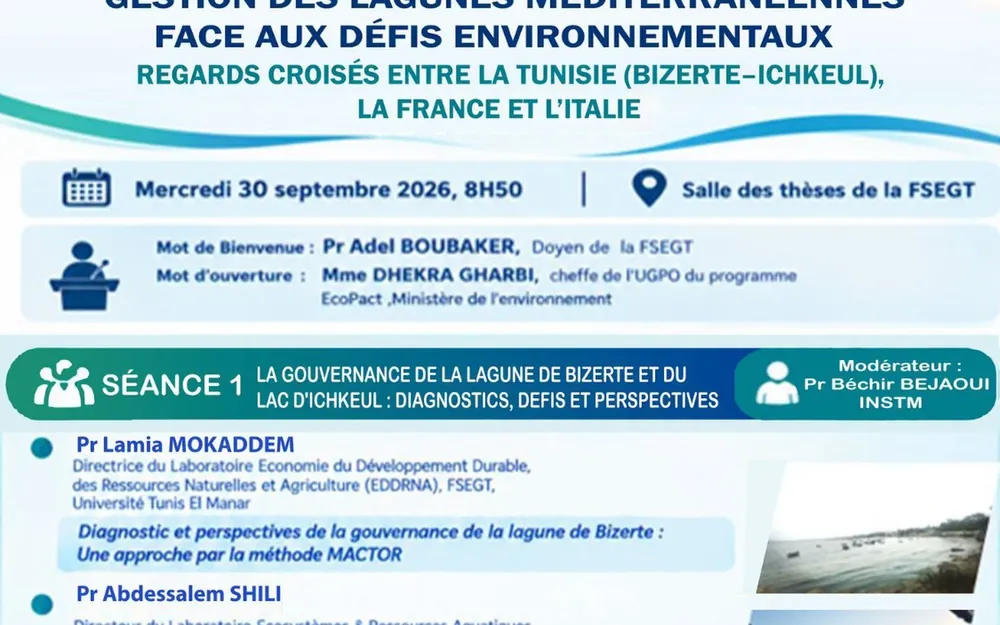
The LEDDRNA laboratory of the Faculty of Economic Sciences and Management of Tunis held the international seminar “Gouvernance et gestion des lagunes méditerranéennes face aux défis environnementaux: regards croisés entre la Tunisie (Bizerte–Ichkeul), la France et l’Italie” in the thesis room of the faculty. The seminar was part of the GEL GINTEL Bizerte project, co-financed by the European Union.
The seminar was opened by FSEGT Dean Prof. Adel Boubaker and Dhekra Gharbi, head of the management unit (UGPO) of the EcoPact programme at the Ministry of Environment. The first session, moderated by Prof. Béchir Bejaoui of the National Institute of Marine Sciences and Technologies, addressed the governance of the Bizerte lagoon and Lake Ichkeul, with contributions from Prof. Lamia Mokaddem, director of the LEDDRNA laboratory, and Prof. Abdessalem Shili of the National Agronomic Institute of Tunisia.
Programme of the seminar on the governance of Mediterranean lagoons, FSEGT · Source: official UTM Facebook page
GEL GINTEL Bizerte: governance and integrated management of the lagoon
The GEL GINTEL Bizerte project deals with local environmental governance and the integrated management of the Bizerte lagoon, with the aim of supporting the local population. It is led by the FSEGT research laboratory on the economics of sustainable development, natural resources and agriculture (LEDDRNA), with the Sys’Com laboratory of the National Engineering School of Tunis (ENIT) as co-applicant. The project is financed by the European Union and belongs to the integrated programme for the depollution of the Lake of Bizerte region, run by the National Agency for Environmental Protection (ANPE).
The project has six components: building socio-economic and environmental knowledge of the lagoon ecosystem; developing sustainable fishing and aquaculture policies and an integrated exploitation strategy; improving the understanding of eutrophication through a living lab approach; proposing an artificial-intelligence platform to monitor eutrophication trends; building stakeholder capacity in the Sustainable Development Goals, environmental management and regulations; and communication. The lagoon is a pollution hotspot linked both to the Mediterranean Sea and to Lake Ichkeul, a Ramsar site and UNESCO Man and the Biosphere reserve.
Fish Living Lab: a participatory workshop on artisanal fishing in the Bizerte lagoon
The first activity of the Fish Living Lab of the GEL GINTEL Bizerte project was a participatory workshop held at the municipality of Menzel Abderrahmane, in the Bizerte region. It was organised by the LEDDRNA laboratory of FSEGT with the Bizerte branch of the JCI association. The Fish Living Lab aims to stimulate value-added innovation in artisanal fishing and shellfish farming, and the workshop concentrated on analysing problems and diagnosing the state of fishing in the lagoon.
Participants included fishers, shellfish farmers, farmers and other lagoon stakeholders, among them unions, government agencies, environmental bodies, local municipalities and young researchers; the organisers noted that industrial actors were absent. The exchanges identified the relations among the stakeholders and the main challenges facing artisanal fishing in the lagoon, and the results were meant to guide the researchers in developing innovations for the sector.
Household and stakeholder survey around the Bizerte lagoon
Within the same project, FSEGT called for enumerators and a survey supervisor to carry out a field survey of the local population of the Bizerte lake watershed. The survey was designed to reach residents and households, fishers and shellfish farmers, farmers and industrialists in six delegations: Bizerte Sud, Menzel Bourguiba, Menzel Jemil, Zarzouna, Tinja and Bizerte Nord. The call set a sample of more than 400 people and a fieldwork period of about four weeks.
The survey supports the second specific objective of the project, the social and economic analysis of the effects of the depollution programme on the lagoon ecosystem and on the local population. The other two objectives are capacity building and the development of an artificial-intelligence model to identify the effects of eutrophication. FSEGT also called for a research project manager to assist the project leader with planning, budget control and scientific and financial reporting.
Training course on the economic valuation of lagoon ecosystem services
As part of the capacity-building component of the project, the LEDDRNA laboratory of FSEGT called for a trainer to deliver a four-day course, estimated at 24 hours, on the economic valuation of lagoon ecosystem services. The course is intended for officials of the National Agency for Environmental Protection (ANPE) and the Coastal Protection and Planning Agency (APAL) and for researchers of UTM and the University of Carthage, and was planned at the premises of FSEGT.
The terms of reference cover the economic theory and methods used to value natural capital, applications to Mediterranean lagoons including the case of the Bizerte lagoon, non-monetary values such as relational values, health and well-being, the role of ecosystems and their services under global change, and the organisation and analysis of perception studies. The trainer must present a simplified guide and issue an attendance certificate to the participants.
Workshops on the Sustainable Development Goals and environmental governance in Bizerte
The project also called for a trainer to lead workshops on the Sustainable Development Goals and environmental governance for about thirty participants: representatives of ANPE, the regional agricultural development commissariat (CRDA) and APAL, together with non-governmental organisations, companies and communities of the Bizerte region. The workshops were planned in Bizerte, and the LEDDRNA laboratory was to issue the training certificates.
The terms of reference list objectives such as understanding the scope of the Sustainable Development Goals, methods for aligning policies with them, ways of involving government agencies, NGOs, companies and communities in environmental decisions, and data-collection and monitoring systems for objectives such as water quality (SDG 6) and marine health (SDG 14). Participants were also to learn to use SDG indicators to measure environmental results with transparency and accountability.
Further training calls and project team of GEL GINTEL Bizerte
The capacity-building programme continued with calls for trainers in integrated cost-benefit analysis, covering economic, environmental and social dimensions, and in carbon accounting and carbon footprint. Each is a four-day course of 24 hours at FSEGT. The cost-benefit course is aimed at officials of the Ministry of Environment, ANPE and the Ministry of Agriculture, Water Resources and Fisheries, and at researchers of FSEGT and the University of Bizerte, with modules on foundations, economic and financial analysis, the integration of environmental and social impacts, and practical decision-making.
The project team was strengthened through calls for a communication manager, who drafts a three-year communication plan and runs the project’s social media, for a doctoral student or PhD holder in economics, and for a technical adviser specialised in statistical and econometric analysis. The carbon course, for its part, trains participants to calculate the carbon footprint of a person or an organisation, to identify the main emission sources and to build an action plan to reduce emissions.
Dredging and nutrient release in the northern Lake of Tunis
The northern Lake of Tunis is a lagoon of about 24 square kilometres with an average depth of 1.5 metres, connected to the Gulf of Tunis by the Kheireddine Channel. It was long used as a receptacle for wastewater and rainwater from the city of Tunis and neighbouring towns, which caused eutrophication and mass mortality of organisms. The restoration programme dredged about 10 million cubic metres of material, mainly in the north and in the exchange channel with the sea, and was followed by lower nutrient levels, a clear reduction in chlorophyll biomass and the return of marine animal and plant species.
Researchers of the Laboratory of Mineral Resources and Environment of the Faculty of Sciences of Tunis (FST) studied how the dredging carried out decades earlier to restore the northern Lake of Tunis still influences the release of nutrients from the sediment. The authors, Haïfa Ben Mna, Walid Oueslati, Mohamed Amine Helali and Ayed Added, analysed three sediment cores taken in dredged and undredged areas of this Mediterranean lagoon. The study was posted as a preprint and later published in the Journal of Sedimentary Environments.
According to the abstract of the preprint, the cores showed a diffusion of nitrogen and phosphorus from the sediment towards the water column. Compared with sediments sampled before dredging, the effect of dredging remains very marked: organic carbon contents are two to 9.5 times lower, ammonium fluxes fell 153-fold and phosphorus fluxes fell by a far larger factor, reported as about 80,000. The authors conclude that this explains the improvement in the quality of water and sediment in the northern lake.
Microplastics trapped in Posidonia seagrass balls along the Tunisian coast
A study co-authored by Thouraya Barhoumi-Slimi of the Laboratory of Structural (Bio)Organic Chemistry and Polymers of the Faculty of Sciences of Tunis (FST), with colleagues of the National Institute of Marine Sciences and Technologies and the University of Carthage, examined microplastics trapped in aegagropiles, the fibrous balls formed by Posidonia oceanica seagrass, at four sites along the Tunisian coast. It appeared in Frontiers in Marine Science.
Microscopy showed that red and blue microplastics dominated at all four sites, with black fibres and fragments the most frequent forms. Nuclear magnetic resonance and infrared spectroscopy identified polystyrene at three sites, and ethyl vinyl acetate, polyethylene terephthalate and polyvinyl chloride at two sites each. The authors link the contamination to human activity and the extensive use of plastic, and they stress the need for continued monitoring of microplastics in seagrass beds to protect Mediterranean coastal ecosystems.
Microplastics on the beaches of Djerba Island
Researchers of the Faculty of Sciences of Tunis (FST) and the National Institute of Research and Physico-chemical Analysis, with first author Mohamed Guesmi, characterised microplastics on eight beaches of Djerba Island in southern Tunisia. The study, published in the Euro-Mediterranean Journal for Environmental Integration, examined the occurrence, concentration and polymer composition of microplastics produced by degraded plastic waste, and assessed how human pressures and natural coastal processes together shape their distribution in the Mediterranean.
Concentrations ranged from 23 particles per kilogram at Gallela Beach to 126.67 particles per kilogram at Yati 2 Beach, and 65 percent of the microplastics accumulated in the dune zones. Polyethylene was the most abundant polymer, followed by polypropylene and polystyrene. The study links the pollution to tourism, fishing and urban runoff, notes the influence of wind and dune shape, and calls for sustainable waste management on Djerba and neighbouring coasts such as Zarzis.
Plant biotechnology students visit an aquaculture pilot station
Third-year Plant Biotechnology students of the Higher Institute of Applied Biological Sciences of Tunis (ISSBAT) made a study visit to the pilot station of the Technical Centre for Aquaculture (CTA) as part of their training. They followed the hatching, rearing and fattening of tilapia and Chinese carp, and a media-bed aquaponics system that combines fish farming with the cultivation of tomato, mint and zucchini.
The students also learned how the physico-chemical parameters of the system are measured. ISSBAT thanked the Director General of the centre, Moncef Khniss, the director of the pilot station, Ramzi Charrabi, and the station technician for their welcome.
Pollution reduction policy with a focus on coastal and marine ecosystems
UTM published a pollution reduction policy that covers air, water, land and coastal pollution and acknowledges the importance of Tunisia’s coastal and maritime ecosystems for biodiversity, local economies and the well-being of communities. One of its objectives is to protect these ecosystems from pollution, with a special focus on raising awareness of coastal and marine pollution among students, staff and the wider community.
For coastal and maritime ecosystems, the policy commits the university to prevent marine pollution through campaigns on the risks of plastics and other pollutants, to reduce campus activities that contribute to coastal pollution, to partner with marine conservation organisations, to promote the sustainable use of coastal resources while avoiding overfishing and unregulated coastal development, and to encourage research on the health of coastal and marine ecosystems. It also provides for the reduction of single-use plastics on campus, the segregation of waste and a regular review of results.
The policy further provides for the integration of pollution reduction into the academic curriculum, so that students take part in research and projects on pollution, for training of university staff in pollution prevention, and for the regular collection of data on water quality, air quality and waste management, to be reported in a sustainability report.
Biodiversity policy: protection of aquatic species and sustainable fishing
The biodiversity policy for the campus of UTM commits the university to conserve rare and endangered species in line with European Union recommendations and the Red Lists of the International Union for Conservation of Nature (IUCN), and gives a particular place to aquatic species and sustainable fishing practices. Its principles include studies to identify threatened species on campus and in surrounding ecosystems, regular monitoring of freshwater and marine species in local water bodies, and protected areas on campus and in local aquatic environments.
The policy also provides for the identification and protection of fish species vulnerable to overfishing or habitat loss, the promotion of sustainable fishing, awareness campaigns on biodiversity loss with an emphasis on aquatic ecosystems, the inclusion of endangered-species conservation in university curricula, and cooperation with the IUCN, European networks, fisheries management bodies and non-governmental organisations. Key indicators are to be defined to measure progress in protecting aquatic and terrestrial biodiversity.
Teaching and outreach strategy on maritime and aquatic sciences
The sustainable education and teaching strategy of UTM includes a strand on maritime and aquatic sciences. It describes modules and programmes on marine biodiversity conservation, sustainable fisheries and aquaculture practices, coastal zone management and marine pollution control, and the policy and regulatory frameworks for maritime sustainability. Research and community engagement are said to address overfishing and illegal, unreported and unregulated fishing.
The strategy also describes training for local fishing communities and small enterprises in sustainable fishing techniques and environmentally friendly aquaculture, and outreach programmes for schools and local communities on marine conservation, pollution reduction and the importance of healthy aquatic ecosystems. Among the master’s programmes listed by UTM, FST offers a programme in the biology of aquatic ecosystems and ENIT one in the modelling of hydraulics and environment.
Research laboratories working on aquatic ecosystems, coasts and water
The list of UTM research structures working in sustainability fields includes several laboratories relevant to SDG 14. At FST, the laboratory of Biodiversity, Parasitology and Ecology of Aquatic Ecosystems, headed by Sihem Bahri, and the laboratory of Ecology, Biology and Physiology of Aquatic Organisms, headed by Monia Trabelsi, study life in aquatic environments, while the Mineral Resources and Environment laboratory and the Desalination and Water Treatment laboratory, headed by Chiraz Hannachi, address sediments and water.
At ENIT, the laboratory of Modeling in Hydraulics and Environment, headed by Hatem Kanfoudi, and at FSEGT the laboratory of Economics of Sustainable Development, Natural Resources and Agriculture, headed by Lamia Mokaddem, complete this research base, which supports the studies on lagoon governance, pollution and fisheries reported under this goal.
Take the SDG 14 report with you
The 2026 report for SDG 14 is a 8-page brochure with every activity and photograph from this page.