Climate action at the University of Tunis El Manar (UTM) covered mitigation, adaptation and risk. Cooperation agreements on the environment and on water security sat alongside scientific events on climate-related insurance risks, artificial intelligence for climate policy and the energy transition. The UNESCO Chair on Water, Waste and Energy at the National Engineering School of Tunis (ENIT) hosted lectures and organises an international conference on resilient cities, and UTM reports its greenhouse-gas emissions against staged net-zero targets.
Framework agreement with the Environment Research Centre of Annaba
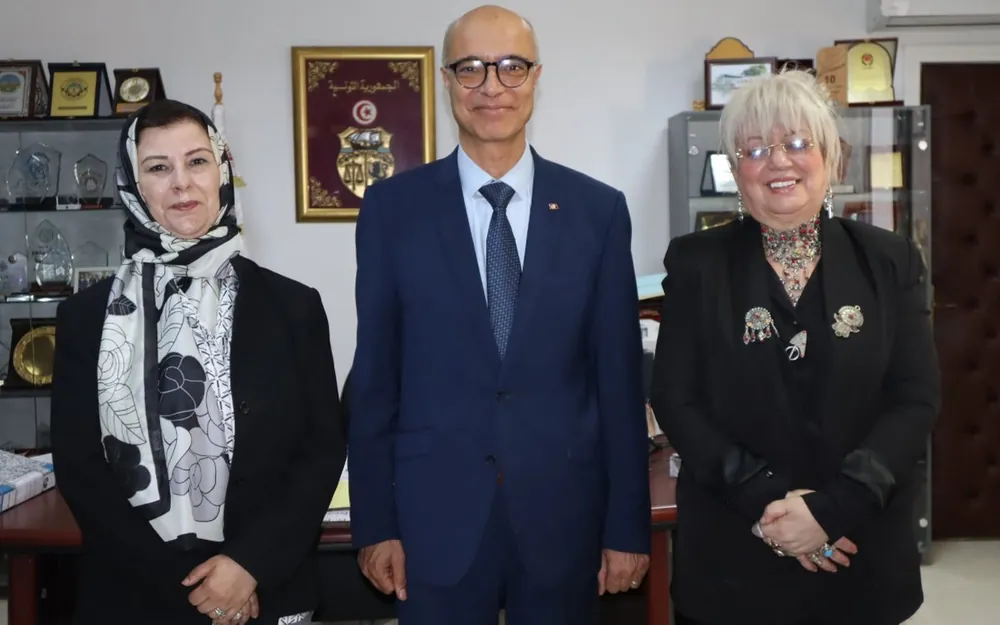
UTM President Prof. Moez Chafra received Prof. Zihad Bouslama, who heads the National Centre for Research in Environment (CRE) of Annaba, Algeria, and the two institutions signed a framework agreement on environmental cooperation. The agreement aims to strengthen academic cooperation and to develop joint projects that respond to current ecological challenges, with the ecological transition named as a field of work.
Both sides stressed the need to pool efforts and exchange expertise, to make better use of scientific research results and to reinforce cooperation mechanisms. According to UTM, the talks also explored ways to strengthen Tunisian-Algerian scientific cooperation on the environment. The agreement fits UTM’s priority sectors, which include the ecological transition, and its aim of raising its regional and international profile.
Water security: agreement with the national water authority and a living lab at FST
UTM signed a cooperation agreement with the General Directorate of Water Resources (DGRE) of the Ministry of Agriculture, Water Resources and Fisheries at the Faculty of Sciences of Tunis (FST). The agreement aims to put the results of scientific research and modern technologies at the service of national water security, and UTM described it as a strategic step in facing water scarcity and climate change. The ceremony also marked the creation of a living lab for water protection at FST, within the Euro-Mediterranean project PRIMA SAVE Water.
The living lab, referred to in the press as the Living Lab SAVE water, is meant to break with purely theoretical approaches and to turn scientific projects into field solutions, with support for the agricultural sector and for water-resource management. FST also published a call for a post-doctoral researcher for the PRIMA SAVE Water project. PRIMA, the Partnership for Research and Innovation in the Mediterranean Area, funds research on water management, farming systems and agri-food chains, and its water priorities include resilience to shortages.
Pilot project using AI and GIS to monitor irrigation water and climate impacts
A pilot project funded under PRIMA was launched on a farm in the Jedaida delegation of Manouba governorate to monitor irrigation water with artificial intelligence, geographic information systems and remote sensing. The Faculty of Sciences of Tunis is the implementing partner, and the Ministry of Agriculture, the General Directorate of Water and UTM support the experiment. Researcher Salwa Saidi, who conceived and leads the project, explained to the national news agency that it compares monitoring methods at two contrasting sites, Manouba in the north and Gabès in the south, and assesses how climate change affects each region in order to propose locally adapted solutions.
Equipment installed in one artesian well per zone gives farmers instant measurements of water parameters, in particular salinity, to identify the causes of salinisation. The data are processed with artificial intelligence and GIS and shared with farmers, with the aim of reducing the effect of rising salinity, falling rainfall and waterlogged clay soils on soils and crops. The project plans to widen the sample to more farmers and involves universities and researchers from eight other countries. PRIMA funding amounts to 45,000 euros per year within a total budget of 2.6 million euros shared among the partners.
Climate-related risks and insurance: scientific event at ENIT
ENIT held the scientific event ‘Future of Insurance: Emerging Risks and Innovative Tools’. The first day was devoted to scientific presentations from academia and industry. The second day brought two thematic panels, on Tunisian insurance facing emerging risks and the data revolution and on modelling challenges linked to such risks, together with a hackathon on current insurance and risk challenges.
The programme named climate change among the emerging risks, alongside cyber-attacks, longer life expectancy and new mobility models. Technical topics included advanced actuarial models for rare and extreme events, parametric insurance, big data and generative artificial intelligence for pricing and fraud detection, and smart contracts for claims management. Speakers came from ENIT and the Faculty of Sciences of Tunis, from universities in France and Portugal, and from the insurance and consulting sectors.
AI, sustainability and climate change: workshop at the Diplomatic Academy of Tunis
The Faculty of Economic Sciences and Management of Tunis (FSEGT) and UTM, through LaREQuaD, co-organised an international workshop at the Diplomatic Academy of Tunis on the use of artificial intelligence for sustainability and against climate change. The other organisers were the Tunisian Institute for Strategic Studies (ITES), Paris School of Business, Paris School of Technology & Business, Université Paris 1 Panthéon-Sorbonne and the Telfer School of Management of the University of Ottawa, and the Centre for Research on Energy and Climate Change was among the partners.
Discussions covered the integration of artificial intelligence into public policy on the energy, ecological and digital transitions, climate resilience, water stress and food sovereignty, and the link between strategic research and policy implementation. Axel Gastambide, technical director of the Savoirs Eco project funded by the European Union and implemented by Expertise France, opened the day, and Sami Ben Jannet, Director General of ITES, closed it. Recommendations included realistic roadmaps with measurable results, a regulatory framework adapted to new technologies, action on the skills gap and weak funding for high-impact innovation, and the inclusion of research in public debate.
UNESCO Chair on Water, Waste and Energy: a research platform for resilient cities
The UNESCO Chair on Water, Waste and Energy is hosted at ENIT within the LAMSIN laboratory, and a UNESCO Chair room on the ENIT campus serves as the venue of its lectures. It brings together researchers from several disciplines and partners in Tunisia, France and Morocco, among them architecture and urban-planning teams, the environmental biotechnology laboratory of the French institute INRAE and Ibn Tofail University. Its stated aim is to design a model of sustainable cities adapted to Tunisian ways of life, to rethink water management and the energy transition, and to turn research and innovation into action in the field.
Case studies include Ariana, a dense urban city next to Tunis, and Toujane, a historic village in southern Tunisia with its new town. The Chair’s website lists SDG 13 among the goals it serves, next to SDG 11 as its main link, and states that the Chair organises annual events with partners, including hackathons and seminars on emerging technologies. The lecture series and the international conference on resilient cities described in the following entries belong to this programme.
UNESCO Chair lectures on sustainable development, multilateralism and ecological transition
The Chair held a lecture titled ‘No future without sustainable development’ in its room at ENIT. The speaker, Dr Ursula A. Vavrik, holds a doctorate in economics and social sciences from the University of Economics in Vienna, is founder and president of the NEW WAYS Center for Sustainable Development, and is a former expert of the European Commission on environmental matters. The talk set the Sustainable Development Goals in the context of the nine planetary boundaries identified by the Stockholm Resilience Centre and reviewed climate change, which the abstract states has exceeded the 1.5 degrees Celsius warming threshold, together with droughts, water scarcity, ecological disasters and ocean acidification.
A second lecture by Dr Vavrik addressed multilateralism in the context of sustainable development. The summary recalls that sustainable development emerged from the Rio summit, which produced the conventions on climate change and biodiversity, and that many multilateral environmental conventions followed, leading to the Sustainable Development Goals. It argues that global problems can only be solved through international cooperation, notes gaps such as the absence of any UN convention on agricultural soils, and observes a trend of turning away from multilateralism.
A third session presented Tunisia’s national strategy for the ecological transition. It was given by Dr Awatef Messaï, a director and chief engineer at the Ministry of Environment and an expert in the auditing of water systems, and took place in the Chair room at ENIT.
Water treatment and desalination conference: climate resilience and the nexus
UTM collaborated with the Tunisian Desalination Association in the tenth edition of the Conference on Water Treatment and Desalination (CMTDE), held in Hammamet under the theme ‘Water, energy, food and ecosystems: an essential link (Nexus)’. According to UTM, the conference was also organised with the European Desalination Society and under the auspices of the Ministries of Higher Education and Scientific Research and of Agriculture.
The programme covered sustainable desalination and water reuse, membrane technologies, environmental impacts and digital solutions for water management, with dedicated sessions on resilience to climate change, water governance and food and water security policies in the Mediterranean region. The audience comprised doctoral students, teacher-researchers and water-sector professionals, and experts from several European countries and Algeria presented case studies and concrete projects linking academic and operational actors.
Health systems and climate challenges: the African Health Security Index forum
UTM organised the first Tunisian-African forum on resilience, risk management, pandemics and social justice in health, within the African Health Security Index project led by Prof. Hanan Boussi of UTM. UTM President Moez Chafra and the Director General of International Cooperation at the Ministry of Higher Education and Scientific Research took part. Partners included the Pandemic Center of Brown University, the Fondation Sciences pour l’Afrique, the Ministries of Higher Education and of Health, the Institut Pasteur de Tunis, the Faculty of Medicine of Tunis and the veterinary research institute.
The index assessed 64 African countries on their preparedness for health risks and epidemics, and one of its criteria is the capacity of states to meet climate challenges. Speakers linked the emergence of new diseases partly to the climate change facing the African continent, which makes the preparedness of health systems an issue of climate adaptation. Tunisia ranks well on the index, especially on health investment, with weaknesses in communication and in publishing research in English.
Mediterranean university assemblies on the ecological transition and renewable energy
UTM, Sfax and Kairouan were the three Tunisian universities taking part in the assemblies of the Mediterranean Alliance for Research and Education (MARE) in Palermo, hosted by the University of Palermo. MARE is a network of eleven Italian universities that seeks to strengthen academic partnerships across the Mediterranean, especially with Tunisia, Morocco, Algeria and Mauritania.
The discussions addressed strategic challenges shared by Mediterranean countries, among them the ecological transition, renewable energies, One Health and the digital transition, together with dual degrees, joint master’s programmes and student mobility. UTM announced its participation on its social media accounts.
Hydrogen and new energy technologies: events at ENIT and FST
ENIT hosted the Conference on New Energy Technologies in its Mokhtar Laatiri auditorium, under the Bund-Länder programme. The conference was opened by ENIT Director Kamel Ben Saad, Nina Vogel-Falahatkar of the Bavarian State Chancellery and Prof. Chiheb Bouden of ENIT and the Tunisian-Bavarian Green Hydrogen Hub. Prof. Bouden presented the role of the Hub in catalysing research projects in Tunisia and its roadmap, and a speaker from Bavaria presented developments in the Bavarian hydrogen ecosystem and its international collaboration.
FST hosted the event ‘Green hydrogen: a pillar of the energy transition’, organised by the association OSIRIS with the Centre for Research and Energy Technologies (CRTEN) and the faculty. Green hydrogen, produced by water electrolysis powered by renewable energy, is treated in UTM’s reports as a pathway toward industrial decarbonisation, because it emits no greenhouse gases when used and can be stored and distributed flexibly.
ENIT researcher in the Tunisian delegation at an international energy-transition exhibition
A delegation of Tunisian researchers took part in KEY, an international exhibition on the energy transition held in Rimini, Italy. Afef Ben Abdelghani Bennani, lecturer and researcher at ENIT, told the national news agency that scientific research is a fundamental pillar of the energy transition and, for a Tunisia facing an energy deficit, a strategic and vital issue. She cited climate change and the country’s strong renewable-energy potential, energy storage and grid integration, the training of young researchers and the adaptation of solutions to the local context.
She also linked the energy transition to public health through the reduction of air pollution, and described a just transition as one that guarantees universal access to clean energy, protects workers in fossil-fuel sectors and builds the resilience of vulnerable communities.
Net-zero roadmap and emission reporting by scope
UTM reports its greenhouse-gas emissions by scope and links the reporting to a long-term net-zero roadmap. Its Board of Governors set monitoring indicators aligned with the Tunisian government’s commitment, with staged targets: Scope 1 first, Scope 2 next and Scope 3 as the long-term horizon. The inventory follows the Greenhouse Gas Protocol corporate standard, uses an operational-control boundary covering the UTM campus establishments and counts carbon dioxide only. Scope 1 covers natural-gas combustion for heating, laboratories and canteens and fuel used by university-owned vehicles and buses; Scope 2 covers purchased electricity; Scope 3 covers business travel, wastewater treatment and staff and student commuting.
The roadmap re-baselines total emissions in a reference year and aims at a 29% reduction over seven years, with an initial annual target of 6% that was recalibrated to a 10-25% range after the pandemic. Action is organised in four work streams: energy and water, travel and transportation, commuting, and waste. The inventory tables show total emissions falling from 36,688 tonnes of carbon dioxide equivalent in the reference year to 24,525 in the final year of the series, with Scope 3 accounting for 74% of the final total. The EU-funded Med-EcoSuRe project supports reporting across the three scopes.
Climate and sustainability policy: operation, awareness and research
UTM’s published climate policy rests on three pillars. Operation covers the monitoring of energy and water consumption, energy-efficient and green buildings to cut emissions, investment in renewable energy, biodiversity protection and responsible use of natural resources, within a framework named UTM-Ecological and Sustainable with targets on green infrastructure, zero paper, zero plastic, zero emissions and zero carbon. Awareness covers education on the impacts of climate change, the inclusion of sustainability topics in study plans and programmes that support sustainable-development frameworks. Research promotes work on environmental protection and on new sustainable technologies.
The policy lists priority themes and linked projects, among them agriculture and environment, ecological transport, water governance, water and climate activities, renewable energy, mechanical engineering and sustainability, and geology, earthquakes and climate change. UTM states that it is an active member of the UN Sustainable Development Solutions Network and has joined the International Universities Climate Alliance and the Higher Education Sustainability Initiative.
Take the SDG 13 report with you
The 2026 report for SDG 13 is a 8-page brochure with every activity and photograph from this page.