For SDG 12, the University of Tunis El Manar (UTM) and its establishments combined student innovation with changes in the way the institution operates. Cross-border and community hackathons explored circular-economy and community-business models, while digital services, quality-management certifications and published policies on waste, paper, plastic, food and purchasing framed responsible institutional practice. The UNESCO Chair on Water, Waste and Energy, hosted at the National Engineering School of Tunis (ENIT), added lectures and research on resource reuse and sustainable production.
First cross-border hackathon: digital solutions for the circular economy
UTM took the initiative for the first hackathon bringing together students from Tunisia, Algeria and Libya, held at the International Centre for Trainer Training and Pedagogical Innovation in Tunis under the slogan ‘Digital solutions for a circular economy’. Nine cross-border teams were formed, each with one Tunisian, one Algerian and one Libyan student and a coach. Partner universities included Jendouba, Sousse, Derna, Tobruk, Batna and Khenchela, the Libyan Open University and the Higher School of Management and Digital Economy (ESGEN). Prof. Mounia Najjar of UTM explained to the national news agency that the aim was to build cooperation among students of the Maghreb and to rethink production and consumption patterns in view of regional environmental challenges, and that later editions would be held in the participating countries.
The jury comprised representatives of UTM, the University of Batna, ESGEN and the sponsor. The first prize went to the Hope Team of the University of Khenchela, which converts date pits into natural carbon used in a water and air filter. The second prize went to the Maghreb Geeks team of UTM for a three-part platform that rents out unused business equipment, labels and resells defective products at lower prices, and sells near-expiry products to consumers. The third prize went to Ecovisions of ESGEN for a platform on which users buy, sell, exchange, repair or donate unused items, intended to reduce waste and widen access to lower prices.
2nd cross-border hackathon in Batna on digital solutions for renewable energy
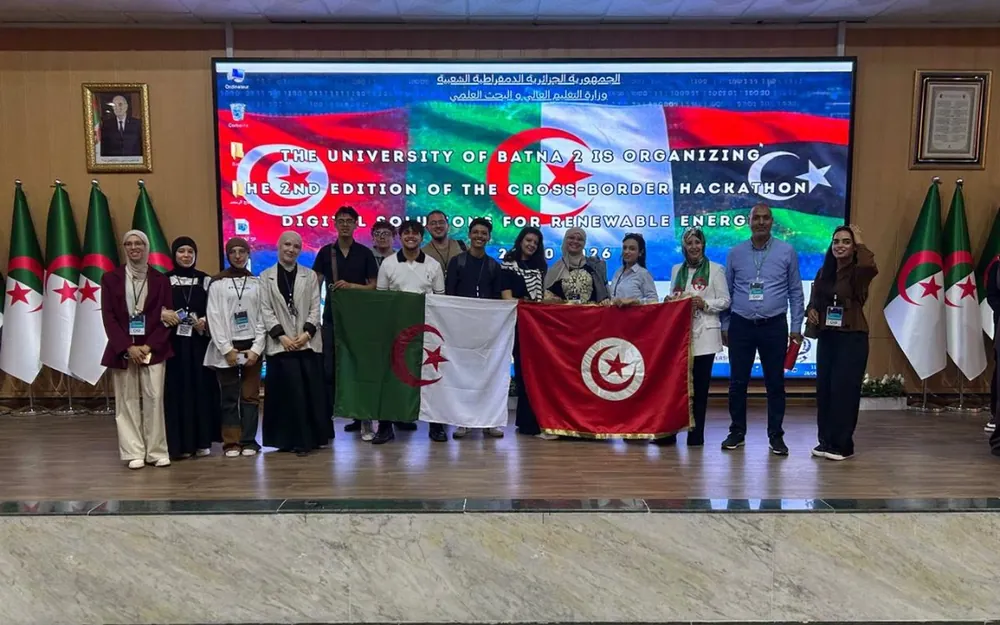
The second edition of the cross-border hackathon of Tunisian, Algerian and Libyan universities was hosted by Batna 2 University in Algeria on the theme ‘Digital solutions for renewable energy’. It followed the pilot edition held in Tunis at UTM’s initiative, which had been devoted to the circular economy. UTM reports that it took part in the organisation on behalf of Tunisian universities. The rules asked each country to be represented by four universities, each sending three students, two coaches and one coordinator, with multidisciplinary teams of three students from information technology, economics and management. The stated aims were working prototypes, applications and platforms for local energy and environmental problems, training in business-model design and pitching, and a lasting cross-border academic network.
UTM and Batna 2 University also drew up a shared strategic vision for scientific and digital cooperation at a joint colloquium on innovative and intelligent information technologies in Hammamet. Its four recommendations covered joint doctoral supervision and staff exchange, a shared digital research platform for Tunisian and Algerian researchers, the conversion of research projects into start-ups, and the orientation of intelligent research toward vital sectors such as digital health, smart agriculture, renewable energy and cybersecurity.
Tunisian and Algerian teams at the 2nd cross-border hackathon, Batna 2 University · Photo: official UTM Facebook page
HacKa2’OOUN, 1st edition: student community businesses for the SDGs
The first edition of the student hackathon that UTM counts as the start of HacKa2’OOUN took place at the Cité des Sciences de Tunis. Published announcements present it as the first hackathon on social entrepreneurship, organised by the Office des Œuvres Universitaires pour le Nord (OOUN) with the student-entrepreneur hub of the University of Manouba, under the supervision of the Ministry of Higher Education and Scientific Research. The theme was entrepreneurship and the creation of community enterprises that serve the Sustainable Development Goals. Thematic and acceleration workshops covered design thinking, Lean Canvas, artificial intelligence with Streamlit, access to markets, financial management and pitch preparation.
In UTM’s account, sixty students worked on community businesses that serve the Sustainable Development Goals, and the event became the first edition of the series that UTM later continued with OOUN. The format ties student entrepreneurship to local social needs, which places the hackathon among the activities for responsible production and consumption.
HacKa2’OOUN, 2nd edition: preparatory meeting between UTM and OOUN
UTM and OOUN started preparing the second edition of the student hackathon HacKa2’OOUN at a working meeting between UTM President Moez Chafra and OOUN’s Director General Abderraouf Ben Fguih. The meeting covered the date and venue, the general programme and the coordination with speakers and logistics partners. The organisers stressed the need to mobilise as many students as possible to secure the reach of the competition and named innovation and civic engagement as its goals. The first edition, held at the Cité des Sciences de Tunis, had brought together sixty students around entrepreneurship and the creation of community enterprises serving the Sustainable Development Goals.
International conference on community companies and the solidarity economy
UTM and the National Register of Companies (RNE) organised an international conference on community companies in Tunis, in implementation of an agreement between the two institutions. National and international experts in the social and solidarity economy and specialists in economic law examined community companies as a lever for sustainable development. Two workshops addressed crowdfunding as a technique of the social and solidarity economy and community companies at the service of that economy.
The organisers presented the meeting as a way to launch a debate on new notions in Tunisian law and to share and develop knowledge and expertise among research specialists. The topic complements the student hackathons on community businesses by looking at the legal and economic framework of local, socially oriented enterprises.
UTM-Innov: student projects in clean agriculture, energy and the environment
The third edition of the UTM-Innov competition, organised by UTM within its student-entrepreneur hub (P2E-UTM), ended with a final at ENIT. About ninety students and recent graduates from UTM establishments took part; roughly forty projects were presented and sixteen teams reached the final, eleven at the idea stage and five with prototypes. The projects covered health, biotechnology, clean agriculture, energy, education and services, together with research in medicine, engineering applications and environmental issues.
Participants received training and coaching through workshops with the Fondation Tunisie pour le développement, as well as legal, logistical and financial support. Selection relied mainly on innovation, feasibility and economic and social impact, and a jury of experts from the Tunisian and Quebec entrepreneurial ecosystems evaluated the finalists. Mouna Marrakchi, president of the organising committee, said that the competition aims to encourage student researchers and project holders to contribute to economic development and to turn research results into projects able to grow from the local to the international level.
UTM-Innov belongs to the activities of P2E-UTM. Its first cohort of student entrepreneurs presented projects at a demonstration day at FST, where the UTM president awarded the national student-entrepreneur status, and the Agence universitaire de la Francophonie supported the creation of the hub.
Elissa: working session with the Tunisian Internet Agency on paperless administration
UTM held a working session with the Tunisian Internet Agency, led by its Chief Executive Siham Trabelsi, on the use of the national electronic correspondence system ‘Elissa’ in UTM’s services. Elissa is an electronic correspondence-management system presented within the national plan to digitise public administration; it handles messaging and document circulation between departments and between central and regional offices.
UTM presents the session as a step toward paperless administration. It complements the university’s published measures on reducing paper use, which include holding paperless meetings and juries where possible and sharing information with participants electronically.
A new data centre at the Faculty of Sciences of Tunis for digital university services
A new data centre was inaugurated within the Faculty of Sciences of Tunis (FST) on the El Manar campus by the Minister of Higher Education and Scientific Research, Mondher Belaïd. It provides data backup and hosts additional cloud services, complementing the main university data centre at La Manouba, and forms part of the national strategy to accelerate the digitalisation of university services.
The Director General of the El-Khawarizmi Computing Centre, the UTM president and the dean of FST attended the inauguration. The ministry presented the project as a concrete example of its push for scientific and technological excellence and for universities that act as innovation hubs, nationally and internationally.
MENAFRICA Digital Summit: digital transformation in universities and administration
UTM organised the MENAFRICA Digital Summit at ENIT, presented in the press as the first MENA summit on digitalisation. The Minister of Higher Education and Scientific Research, Mondher Belaïd, gave the opening speech. The theme linked universities, economic enterprises and the societies of tomorrow, and the programme addressed artificial intelligence and digitalisation in higher education, modern university administration, smart universities and the networking of university libraries, online training, the digitalisation of health, climate and leadership, and the ethical dimension of digitalisation.
Parallel training sessions covered advanced digital skills, artificial intelligence, inclusion and open education, large language models for software engineering, cybersecurity and data protection, blockchain and the metaverse. UTM stated that the summit aimed to assess the state of digitalisation across sectors, share good practices and propose actions for an inclusive and sustainable digital transformation.
Renewal of the ISO 9001:2015 quality-management certification
UTM renewed its ISO 9001:2015 quality-management certification after internal and external audits that covered all of its services and verified compliance with current procedures and the effectiveness of the management system. The renewal followed approval by an external evaluation committee. UTM stated that the aim was to maintain the certification, strengthen its commitment to quality and consolidate a culture of quality and continuous improvement across its structures. It thanked the quality team, the administrative and technical managers and all staff who contributed.
The certificate concerns quality management rather than environmental management. It is listed here because documented procedures, internal audits and continuous-improvement cycles underpin the more specific policies on waste, paper and purchasing that the university has published, and because the audit covered the university’s services as a whole rather than a single establishment.
ISO 21001:2018 certification for the Faculty of Law and Political Science of Tunis
The Faculty of Law and Political Science of Tunis (FDSPT), an establishment of UTM, obtained certification of conformity to ISO 21001:2018, the international standard for management systems of education and training organisations. An external audit ended shortly before the announcement, which UTM published in a communiqué. The faculty presented the certification as a reflection of its commitment to applying international quality standards.
The certification adds to the ISO 9001:2015 certificate renewed for UTM’s services. Like it, it concerns the management of education and training rather than environmental performance, but it shows the extension of formal management systems across UTM’s establishments.
First in Tunisia in the Times Higher Education Sustainability Impact Ratings
UTM ranked first among Tunisian institutions in the Times Higher Education Sustainability Impact Ratings, in the 101-200 band worldwide; five Tunisian universities were placed. The ratings assessed 1,646 universities from 116 countries against 17 indicators linked to the Sustainable Development Goals. They cover four areas: research related to the goals, governance and resource management, inclusive and sustainable teaching with environmental awareness, and cooperation with local, international and civil-society partners.
The press report does not give goal-by-goal results, so the ranking is cited here as a general indicator of institutional sustainability performance, including the management of resources, rather than as a measure specific to SDG 12.
UNESCO Chair on Water, Waste and Energy at ENIT: waste-treatment research and partners
ENIT hosts a UNESCO Chair on Water, Waste and Energy, carried by its LAMSIN laboratory with the environmental biotechnology laboratory of the French research institute INRAE in Narbonne. The Chair is a science chair in which several disciplines meet to pursue sustainable development goals linked to water, waste and energy. Its mission is to gather researchers, decision-makers and civil society to design a model of sustainable cities suited to Tunisian ways of life and to rethink water management, sustainable waste treatment and the energy transition.
One work package applies numerical and applied-mathematics approaches to optimise bioprocesses for waste treatment, with LAMSIN, the INRAE laboratory and Ibn Tofail University in Morocco. The Chair’s partners include the National Agency for Waste Management, the national sanitation office ONAS, the water utility SONEDE, the Ministry of Environment, the Tunisian Association of Urban Planners and Nielsen Recycling Solutions, a Tunisian company that manufactures waste-management and recycling equipment. The Chair’s website lists SDG 12 among the goals to which it contributes.
Lecture on organic agriculture at the UNESCO Chair
The UNESCO Chair held a lecture on organic agriculture in its room at ENIT, given by Dr Ursula A. Vavrik, president of the NEW WAYS Center for Sustainable Development. The talk reported that organic farmland covers about 2.0% of agricultural land worldwide, compared with 10.5% in the European Union and 2.8% in Tunisia.
It presented organic farming as favourable to the climate, to biodiversity, to water use and to phosphate and nitrate cycles, and as a contribution to healthy food and public health. For Tunisia, the summary identifies significant potential for investment and market development in the sector, which links the lecture to sustainable production patterns.
Water reuse at the UNESCO Chair: greywater webinar and nature-based solutions lecture
The UNESCO Chair of the LAMSIN laboratory at ENIT held a hybrid webinar titled ‘Greywater: decentralised treatment and reuse, between science and regulation’. The title frames the decentralised treatment and reuse of household water as a question that sits between scientific solutions and the regulatory framework. Water reuse is one of the Chair’s core themes, and its partners include the national sanitation office ONAS, the water utility SONEDE and the Ministry of Environment.
A later lecture in the Chair room at ENIT, given by Dr Didier Orange, a researcher at the French Research Institute for Development (IRD), addressed nature-based solutions for the treatment and reuse of wastewater and domestic water. Both events fit the circular-city theme on urban water systems and green infrastructure of the Chair’s international conference.
Biotechnology study day: wastewater treatment and ecological waste disposal
A first one-day study session on biotechnology was held at the Maison du vétérinaire in Tunis, organised by the company CTE Consulting Développement in partnership with the Higher Institute of Medical Technologies of Tunis (ISTMT), the National Order of Veterinarians and the AgroFig project linked to the Faculty of Sciences of Tunis (FST). Prof. Ghada Barakat of FST said that the event aimed to bring together research institutions and structures in Tunisia.
The programme covered the role of biotechnology in the medical, environmental, animal and plant sectors. Its environmental part addressed the treatment of polluted water and the ecological disposal of waste, and climate change and new diseases were presented as challenges facing researchers.
Published policies on laboratory waste, plastic and paper, food waste and purchasing
UTM publishes a procedure for waste from laboratories, offices, restaurants, teaching and research laboratories and the medical centre. Laboratory waste is managed as hazardous unless the sorting staff decide otherwise. Each waste type is identified and labelled when the first waste is added, separated into leak-proof containers with tight lids, and boxed so that incompatible chemicals stay apart. Schools and institutes keep pre-printed chemical-waste labels, biohazard bags are excluded for chemical waste, and the cleaning team collects waste for off-site treatment or disposal.
A separate policy sets measures to reduce plastic and paper: alternatives to single-use plastic bags, support for plastic-waste recycling, recycled paper, double-sided printing by default, printing only when necessary, and paperless meetings and juries where possible. A committee appointed by the president is to report to the university council on indicators. The food-waste policy provides for periodic monitoring of the diagnosis carried out by the university catering service, public commitments by the caterer, research on food security and waste reduction, and educational modules on sustainable food.
The sustainable purchasing and procurement policy applies to all academic and administrative departments. It gives priority to products and services with low environmental impact, including eco-friendly, energy-efficient and recyclable materials and reduced packaging and single-use items. It adds social criteria, such as fair labour practices, and a preference for local and regional suppliers, and it requires procurement criteria that evaluate the environmental, social and economic sustainability of suppliers and products.
Take the SDG 12 report with you
The 2026 report for SDG 12 is a 8-page brochure with every activity and photograph from this page.