UTM’s engineers, researchers and students worked for safer, more resilient and more sustainable cities and communities. Colloquia and workshops at the National Engineering School of Tunis addressed urban transitions, sustainable roads, building materials and seismic safety, while road-safety cooperation, campus greening, climate-adaptation hackathons and student projects brought the goal to the university community.
Sport, environment and citizenship: olive-tree planting at FST
The Faculty of Sciences of Tunis (FST) held the event “Sport, environment and citizenship”, which combined sports activities with the planting of olive trees on campus. Interactive sports built cooperation among the participants and were followed by the planting of an olive tree, which UTM presents as a living symbol of urban greening and of a tangible connection to the land.
The event engaged students as active agents in creating greener communities and supported participatory approaches to the development of cities. UTM’s account stresses that integrating nature into built environments improves air quality and well-being, and that the lasting tree stands for an investment in education and civic engagement. The planting is also reported under UTM’s work on life on land.
Working session with the National Road Safety Observatory
UTM held a working session with the Director General of the National Road Safety Observatory, Brigadier Saber Khfifi, with the aim of establishing an academic and scientific partnership on road safety. The partnership is intended to bring academic and scientific expertise to the observatory’s work, in a field that falls under target 11.2 of the sustainable development goals, which calls for safe, affordable, accessible and sustainable transport systems for all.
Seminar on intelligent transport and autonomous vehicles at ENIT
The National Engineering School of Tunis (ENIT) hosted a Bio&TIC seminar for its TICV master’s programme on intelligent transport and autonomous vehicles. Dr Rahim Kacimi of the Toulouse Institute of Computer Science Research, University of Toulouse, presented cooperative perception and V2X communications in networks of connected autonomous vehicles, using the autOCampus platform. Dr Aida Ben Chahida of ENIT spoke on computer security in connected vehicular networks, and Dr Wafa Mefteh moderated the session in the Laatiri amphitheatre.
Créer Bim-Ec study days on inclusive transport and sustainable roads
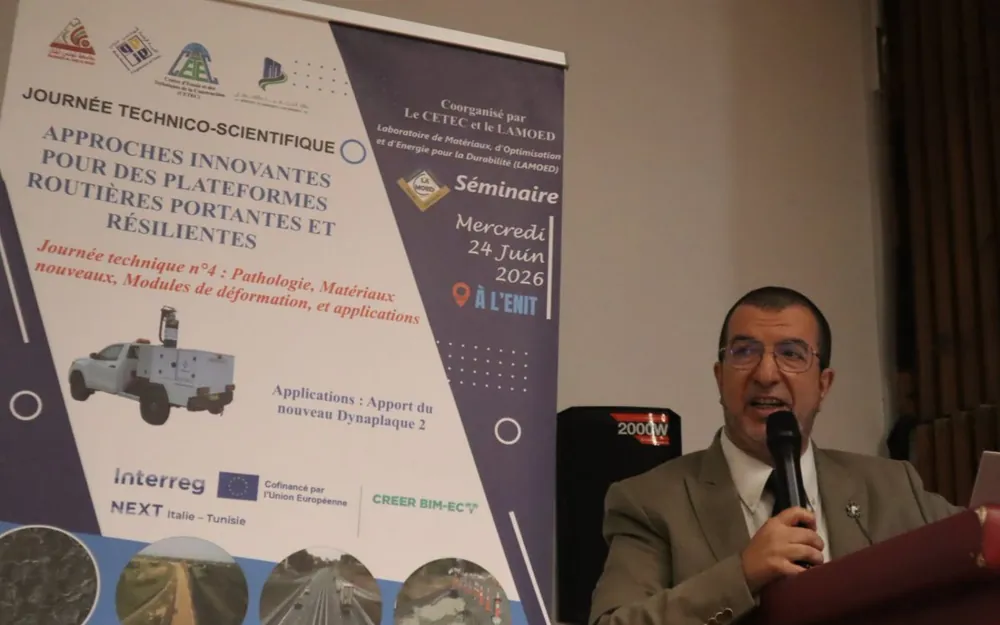
The LAMOED laboratory of ENIT (Materials, Optimisation and Energy for Sustainability) held two study days within the Interreg NEXT Italy–Tunisia project “Créer Bim-Ec”. The first looked at innovative approaches for inclusive and sustainable urban transport. The second, at ENIT, was devoted to innovative approaches for robust structures for sustainable roads.
These themes correspond to target 11.2 of the sustainable development goals, which calls for safe, affordable, accessible and sustainable transport systems for all, with attention to people in vulnerable situations and to persons with disabilities, and to the wider aim of resilient infrastructure.
Science & Villes colloquium: water, waste and energy versus urban transitions
The UNESCO Chair on Water, Waste and Energy for the sustainable development of cities, hosted by the LAMSIN laboratory of ENIT, organised an international multidisciplinary colloquium, “Science & Villes”, on water, waste and energy versus urban transitions. It ran for three days at ENIT, with an organising committee drawn from ENIT, the National School of Architecture and Urbanism, INSAT and other Tunisian institutions. Welcome speeches were given by Nihel Ben Amar, holder of the Chair, and Kamel Ben Saad, director of ENIT, and speakers from the Horizon Europe programme in Tunisia and from the Ministry of Environment, who presented the national strategy for ecological transition, opened the scientific programme.
Five sessions covered sustainable water management, waste in the city, urban energy and energy transition, intersectoral approaches to the water–waste–energy nexus, and artificial intelligence and digital sciences for the city. Contributions included the Urban Water projects in Ariana and Toujane, a participatory project in the Cité Aïcha district of El Mourouj presented as a path towards an inclusive and sustainable city by the president of ICOMOS Tunisia, a study of integrated water and waste management between city and periphery in La Marsa and Sidi Hssine, and the model of community environmental governance of the municipality of Karak in Jordan.
Speakers also addressed tools and policies for the building sector: clean energy in buildings, national initiatives for ecological construction led by the Ministry of Equipment and Housing, and BIM and City Information Modeling as decision-support tools for the governance of the water–waste–energy nexus. The Tunisian Forum for Economic and Social Rights spoke on environmental justice in the management of water and waste, and a speaker of the United Nations Economic Commission for Africa presented sustainable municipal finance for water, sanitation and waste management.
UNESCO Chair lecture on nature-based solutions for wastewater purification and reuse
The UNESCO Chair on Water, Waste and Energy for the sustainable development of cities, held by Nihel Ben Amar and based at ENIT, hosted a conference by Didier Orange, researcher at the Institut de Recherche pour le Développement, on nature-based solutions for the purification and reuse of domestic and agricultural wastewater. The conference took place in the room that carries the Chair’s name at ENIT, and its poster carries the logo of the Friedrich Ebert Stiftung.
PaveTech Workshop on asphalt and pavement technologies with Austrian partners
ENIT hosted the PaveTech Workshop on Austrian–Tunisian collaboration in asphalt and pavement technologies and research, organised with UTM, TU Wien and Austrian partners, sponsored by the Austrian Agency for Education and Internationalization and co-organised by the civil engineering club of ENIT. Welcome speeches were given by ENIT’s director, Prof. Kamel Ben Saad, and UTM’s president, Prof. Moez Chafra. Mag. Stephan Vavrik, designated ambassador of Austria to Tunisia, gave welcoming remarks, and Prof. Jamel Neji, director of the LAMOED laboratory, presented the laboratory.
The programme covered the fate of polymers in recycled asphalt, urban heat island mitigation through cool pavement technologies, experimental approaches to multi-recycled asphalt mixtures, new deflection basin indices for pavement assessment, life-cycle cost analysis of pavement alternatives using Monte Carlo simulation, measures to reduce the environmental impacts and energy consumption of asphalt mixtures (METAsphalt), inverted pavements, chemo-mechanical analysis of bituminous materials, performance-based specifications and the Sponge City principle in Austria. The workshop ended with a session on studying in Austria and on collaboration with TU Wien.
Sustainable building materials, 3D concrete printing and national concrete days
The Civil Engineering Laboratory (LGC) of ENIT organised a workshop on the sustainability of building materials to cut greenhouse emissions and enhance the circular economy, with Prof. Mohammed Sonebi and Dr Vasileios Angelidakis of Queen’s University Belfast. Talks covered sustainable building materials in the Middle East and North Africa region, micromechanical insights for sustainable construction materials through modelling and imaging in 3D, and the question of whether bio-based building materials can deliver CO2-neutral buildings.
The same laboratory invited Prof. Sonebi for a conference on 3D concrete printing, covering the trends, challenges, opportunities and economic potential of this emerging industry. The laboratory also took part, with the Tunisian Concrete Association, in the seventh edition of the national concrete days, a seminar supported by RILEM and held at Hammamet.
Workshop on stabilised compressed earth blocks as a durable building material
The Civil Engineering Laboratory of ENIT held a workshop on civil engineering and sustainable development entitled “Stabilised compressed earth block (BTCS): a durable and high-performing material”, in the Mokhtar Laâtiri amphitheatre. Prof. Karim Miled, director of the laboratory, opened the workshop. Prof. Ahmed Jelidi spoke on the optimisation of the thermal and mechanical performance of the blocks, and Prof. Oualid Limam on self-locking blocks, with modelling of the structure and tests.
Satprem Maïni, architect and director of the Auroville Earth Institute in India, presented the construction in India of a dome of 33 metres in diameter built with stabilised compressed earth blocks, and a question-and-answer session followed. The workshop gave Tunisian civil engineers an example of large-span earth construction and a discussion of earth as a building material for housing and public buildings.
Engineering structures day and seismic isolation conference at ENIT
ENIT hosted the Engineering Structures Day (Journée Ouvrages d’Art) on innovation, durability and seismic safety of engineering structures. It was organised by the Civil Engineering Laboratory of ENIT, the Tunisian Concrete Association and the Directorate General of Bridges and Roads of the Ministry of Equipment and Housing, with the participation of the civil engineering club of ENIT.
The Civil Engineering Department and the LAMOED laboratory also invited Prof. Lotfi Guizani of the École de technologie supérieure of the University of Quebec for a conference on the development of an adapted seismic isolation system, from formulation to characterisation, held in the UNESCO Chair room of ENIT. Both events address the safety of bridges and buildings exposed to seismic risk, a component of resilient and safe human settlements.
Technical day on swelling soils in North Africa
The research laboratory Ingénierie Géotechnique et Géorisque of ENIT and the consulting firm SIMPRO-Tunisie co-organised a technical day on swelling soils: problems, characterisation and case studies in North Africa, held at ENIT. The opening session brought together the UTM President, Prof. Moez Chafra, the ENIT director, Prof. Kamel Ben Saad, the laboratory director, Prof. Essaieb Hamdi, Prof. Mounir Bouassida of SIMPRO-Tunisie and Prof. Marawan Shahin of Tanta University in Egypt, vice-president for Africa of the international society for soil mechanics and geotechnical engineering.
Two oral sessions presented the characterisation of swelling soils in Madagascar, Algeria, Tunisia, Morocco and Egypt, a Tunisian case study on reducing the swelling pressure under the foundation of a building on swelling clay, and a pathological case in Algeria. Understanding the behaviour of such soils bears directly on the safety of foundations, buildings and roads.
ENIT student events on green spaces, civil engineering and reconstruction
ENIT held GreenIT, its event on the ecological importance of trees and green spaces, under the title “Planting the Seeds of a Sustainable Future”. The poster carries the logos of Enactus ENIT and of the civil engineering club of the school, which show the student side of the event.
The civil engineering community of ENIT held its Civil Engineering Day, “Glow & Build”, with an opening ceremony, workshops, a competition, a visit to stands, an announcement of results and a closing ceremony. ENIT also announced a GreenCon 3.0 session on artificial intelligence in post-war reconstruction, described on its poster as a revolutionary tool.
Pilot site for managed aquifer recharge at Oued Souhil
The Higher Institute of Applied Biological Sciences of Tunis (ISSBAT) inaugurated the pilot site of the Horizon Europe project MAR2PROTECT at Oued Souhil, an experimental installation that demonstrates solutions for the controlled recharge of aquifers. The site is meant to strengthen the protection of groundwater and to promote innovative solutions against the effects of climate change, within ISSBAT’s societal commitment and its living lab. It was developed in collaboration with the national institute of research in rural engineering, water and forests (INRGREF).
The inauguration gathered local actors, academics and other stakeholders, in a logic of participatory science and open innovation, and was attended by UTM President Prof. Moez Chafra and a representative of the Ministry of Higher Education and Scientific Research.
ClimAdapt Hack: geospatial data and AI for climate adaptation of territories
UTM students and young innovators took part in ClimAdapt Hack, a national hackathon organised in Sousse by the African Association for Geospatial Development (AGEOS) with the National Forum for Adaptation to Climate Change and several public, academic and private institutions. More than 100 participants from 15 governorates worked on solutions for climate adaptation.
Two challenges were set. The first, OpenGeoAI for climate action, used geospatial data and artificial intelligence for ecosystem monitoring, early warning of extreme climate events and the optimised management of natural resources and territories. The second, on technological innovation and the circular economy, covered educational applications and games, eco-construction, waste reduction, sorting, recycling and waste logistics. UTM describes the event as work on climate-smart infrastructure, adaptive urban systems and sustainable territorial and urban planning.
Systems Week: engineering students design self-sufficient cities
During Systems Week, devoted to sustainable construction and resilient infrastructure, UTM engineering students took on the challenge of building a self-sufficient city. Their projects included self-sufficient schools, smart recycling plants, resilient water systems and eco-districts.
According to UTM, the projects rested on research, reflection and close collaboration, and met their deadlines. They served as learning workshops in sustainable construction, model building and teamwork, and they linked urban sustainability with engineering education.
RISC-Lab Days: drones for firefighting and climate-resilient farming
At the RISC-Lab Days held at ENIT, the robotics, computing and complex systems laboratory presented research projects with a link to safety and resilience. One project develops advanced drone control algorithms for fighting fires, under the Utique cooperation programme. Another proposes a connected and intelligent solution for sustainable cereal farming that is resilient to climate change. The programme also included seminars by guest researchers from the University of Toulouse and from universities in the United States, and talks by the laboratory’s doctoral students.
Seminar on the governance of Mediterranean lagoons at FSEGT
The EDDRNA laboratory of the Faculty of Economic Sciences and Management of Tunis (FSEGT) organised an international seminar on the governance and management of Mediterranean lagoons facing environmental challenges, with crossed views from Tunisia (Bizerte and Ichkeul), France and Italy, within the Bizerte GEL GINTEL project co-funded by the European Union. Lagoons are essential for biodiversity, fishery resources and the local economy, and they are under growing pressure from artificial development, economic activities, climate change and conflicts of use.
The invitation states that participatory and adaptive governance is decisive in reconciling preservation and development. Speakers included Prof. Abdesslam Shili, director of the laboratory of aquatic ecosystems and resources at INAT, University of Carthage, Prof. Rutger De Wit, research director at CNRS, Prof. Charles-François Boudouresque of Aix-Marseille Université, Prof. Vittorio Gazale, director of the Asinara national park and marine protected area, who presented the Italian “Lagoon Contract”, and Prof. Lamia Mokaddem, director of EDDRNA.
First place in Tunisia in the Sustainability Impact ranking
UTM ranked first among Tunisian universities in the Times Higher Education Sustainability Impact ratings, within the global band of 101 to 200. Five Tunisian universities were ranked, and the edition assessed 1,646 universities from 116 countries on 17 indicators linked to the sustainable development goals, among which sustainable cities.
The assessment covers research on the goals, governance and resource management, inclusive and sustainable teaching, environmental awareness, and cooperation with local, international and civil-society partners. The University of Manchester ranked first worldwide, followed by Griffith University in Australia, and Australian, Malaysian and Canadian institutions also appeared in the top ten.
Take the SDG 11 report with you
The 2026 report for SDG 11 is a 8-page brochure with every activity and photograph from this page.