Water research and expertise at UTM span desalination, water reuse, groundwater protection and wastewater surveillance. Its establishments hosted conferences and workshops, signed a national agreement with the water authority, joined European research projects and strengthened regional capacity in environmental surveillance through Institut Pasteur de Tunis.
Faculty of Sciences of Tunis · President of the Tunisian Desalination Association
Our year for SDG 6
UNESCO Chair on waste, water and energy at ENIT
The National Engineering School of Tunis (ENIT), an establishment of UTM, hosts a UNESCO Chair on waste, water and energy, carried by its LAMSIN laboratory of mathematical and numerical modelling in the engineering sciences. The chair is a science chair in which several disciplines meet to pursue the Sustainable Development Goals linked to water, waste and energy. Its mission is to bring together researchers, decision-makers and civil society in order to design a model of sustainable cities suited to the Tunisian way of life, to rethink water management, to improve the sustainable treatment of waste and to support the energy transition. ENIT and the University of Sousse were each honoured with a UNESCO chair, and the ENIT chair covers water, waste and energy.
The work programme is organised in three packages. The first applies applied mathematics and numerical methods to the optimisation of bioprocesses for waste treatment, with the Narbonne laboratory of the French National Research Institute for Agriculture, Food and Environment (INRAE) and Ibn Tofail University in Kenitra. The second concerns the rehabilitation of Tunisian cities in order to create a model city for sustainable development, with teams from ENIT, the National Institute of Applied Science and Technology (INSAT), the National School of Architecture and Urbanism and other partners. The third studies methods of change management adapted to the context in which solutions are applied. The promoters of the chair also refer to the constitutional right to a healthy environment and to safe water, and to the need to raise national energy capacity through renewable and green energy.
Research laboratories working on water at UTM
Several research laboratories of UTM address water directly. At the Faculty of Sciences of Tunis (FST), the Desalination and Water Treatment Laboratory (LR19ES01) works on desalination and water treatment, and the Biodiversity, Parasitology and Ecology of Aquatic Ecosystems Laboratory (LR18ES05) and the Ecology, Biology and Physiology of Aquatic Organisms Laboratory (LR18ES41) study aquatic environments. At the National Engineering School of Tunis (ENIT), the Modelling in Hydraulics and Environment Laboratory (LR99ES19) covers hydraulic and environmental modelling, and the LAMSIN laboratory includes bioprocesses and membrane processes for water treatment among its research axes. At the Faculty of Economic Sciences and Management of Tunis (FSEGT), the laboratory on the economics of sustainable development, natural resources and agriculture (LR20ES14) examines the economics of natural resources, including wetlands. These structures carry the research projects, the chair and the partnerships described in this report.
Greywater: treatment and reuse
The UNESCO Chair of the LAMSIN laboratory at the National Engineering School of Tunis (ENIT) held a hybrid webinar titled “Greywater: decentralised treatment and reuse, between science and regulation”. Greywater is the wastewater produced by baths, showers, washbasins and laundry, without toilet waste, and its decentralised treatment close to the point of production is one option for the reuse of water.
The title placed the topic at the meeting point of scientific knowledge and regulation. The webinar belongs to the activities of the chair, whose partnership framework includes the REUSE and TREASURE networks of the French National Research Institute for Agriculture, Food and Environment (INRAE) and the UNESCO water centre in Montpellier, and which is listed among the projects of the REUSE network on water reuse.
IN2AQUAS: training doctoral researchers for water
The Desalination and Water Treatment Research Laboratory of the Faculty of Sciences of Tunis (FST), referenced LR19ES01, is a partner of IN2AQUAS, a Horizon Europe doctoral network funded by the Marie Skłodowska-Curie Actions. The full title of the network is “Human footprint on water from remote cold areas to the tropical belt. INtegrated Approach TO secure water QUAlity by exploiting Sustainable processes”. The consortium is coordinated by the University of Turin in Italy, and UTM takes part as an associated partner.
The network brings together ten degree-awarding universities, four national research centres, four companies and a specialised facilitator, and it trains fifteen doctoral candidates. The candidates assess how pollutants affect the environment and design green treatment processes that produce safe water, including in extreme conditions, with the possibility of double doctoral degrees in two countries. The three main goals are to assess water quality and predict its response to environmental stress, to restore water quality with near-zero waste discharge, and to scale up and integrate sustainable processes. The case studies cover aquaculture, arid areas and remote cold areas, with attention to water reuse and nutrient recovery.
MAR2PROTECT: protecting groundwater through managed aquifer recharge
The Higher Institute of Applied Biological Sciences of Tunis (ISSBAT), an establishment of UTM, is a key partner of MAR2PROTECT, a Horizon Europe project that aims to safeguard groundwater against the effects of climate and global change. The project is built around a decision support system based on artificial intelligence, which combines technological data with inputs from society in order to improve both the quality and the availability of groundwater through managed aquifer recharge, that is, the deliberate replenishment of aquifers.
ISSBAT contributes advanced tertiary treatment processes designed to limit the infiltration of pollutants into aquifers. The Tunisian case studies are located on the Cap Bon peninsula and serve as a model for the sustainable management of groundwater in semi-arid regions. A pilot site operates at Oued Souhil in Nabeul, and ISSBAT advertised a service contract for the surveillance of this site within the project.
StopUP: protecting the aquatic environment from urban runoff
The Higher Institute of Applied Biological Sciences of Tunis (ISSBAT) is also a participant in StopUP, a Horizon Europe research and innovation action on protecting the aquatic environment from urban runoff pollution, funded under a call on preventing and managing diffuse pollution in urban water runoff. The project set out to elucidate pollution pathways in urban catchments so that interventions can be targeted. It aimed to reduce pollutant loads from urban runoff and combined sewer overflows through monitoring, online sensors, data analysis and the testing of treatment technologies, such as advanced retention soil filters.
ISSBAT was the only Tunisian organisation among the eight participants of a consortium coordinated by RWTH Aachen University in Germany, which also included participants from Belgium, Norway, Italy and the Netherlands. The Institute took part as a signatory of the grant agreement, with a net European Union contribution of 154,875 euros. The project also planned tools to support the selection and implementation of mitigation measures against urban runoff pollution.
SAVE water: geospatial and artificial-intelligence approach coordinated by FST
The Faculty of Sciences of Tunis (FST) coordinates SAVE water, a research project entitled “GeoSpatial and Artificial intelligence technologies: InnovatiVE approach for water resources management”, selected under the Partnership for Research and Innovation in the Mediterranean Area (PRIMA). It is led by Salwa Saïdi of FST and brings together thirteen institutions from Tunisia, Morocco, Algeria, Egypt and several European countries, among them the Technical University of Berlin and research institutions in Italy, France, Portugal and Spain. The project has a duration of 36 months.
The project addresses the rising demand for irrigation and municipal water in dry and overexploited Mediterranean and European regions under climate change. It proposes to use artificial intelligence and geospatial technologies to process water data, to optimise supply services and to bring stakeholders together. The planned outputs include a water-system database built from living-lab data, real-time monitoring and predictive models, a local vulnerability model for protecting high-risk water systems, an analysis of socio-economic effects including pricing and insurance strategies, and a collaborative platform. The project also aims to remedy the lack of a common, open database for decision-makers. FST advertised a call for a post-doctoral researcher for the project in its extension phase.
SAVE water pilot on a farm in the Manouba governorate
Within SAVE water, a pilot experiment was launched on a farm in the Jedaida delegation of the Manouba governorate. It uses artificial intelligence, geographic information systems and remote sensing to monitor the water used for irrigation, with equipment installed in wells to take instant measurements of water parameters and to establish the causes of salinity. The experiment compares the northern site of Manouba with a southern site in Gabès, in order to assess the effects of climate change in each region and to propose solutions suited to local conditions.
The press reports describe falling irrigation-water yields, rising salinity, waterlogged clay soils, lower rainfall and flood risk in the study area. The launch took place with the support of UTM, the Ministry of Agriculture and the General Directorate of Water, in partnership with the regional agricultural development commissariats of Manouba and Gabès, and the head of the Jedaida delegation supervised it. Salwa Saïdi, academic and researcher, was presented as the designer and head of the project. The experiment is meant to be extended to more farmers, with participatory research for food security, and the data processed with artificial-intelligence and GIS tools are intended to help farmers manage irrigation and reduce harm to soils and crops.
Agreement with the national water authority and a living lab at FST
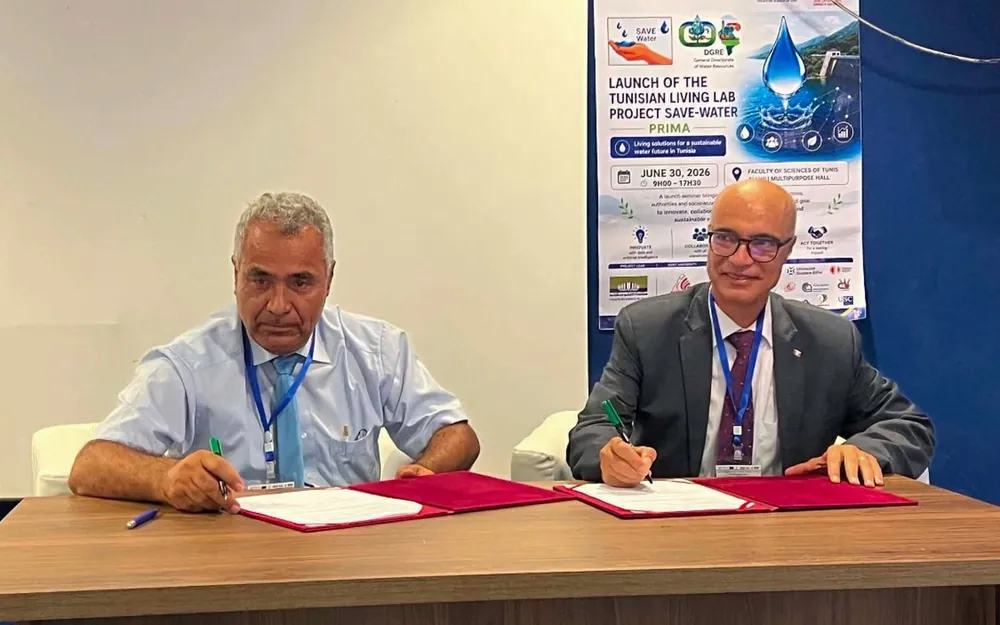
At the Faculty of Sciences of Tunis (FST), UTM signed a cooperation agreement with the General Directorate of Water Resources (DGRE) of the Ministry of Agriculture, Water Resources and Fisheries. The agreement supports national water security by turning research into solutions. It applies the results of scientific research and modern technologies to the challenges of water stress and climate disruption, and it aims to convert the results of scientific projects into practical solutions for agriculture and for the management of water resources. The university described the agreement as a strategic step.
The signing ceremony coincided with the inauguration of a new scientific structure at FST, the Living Lab SAVE water, translated as the living laboratory for water protection. It was created through synergy with the Euro-Mediterranean programme PRIMA SAVE Water, described in the press as a project for the safeguarding of water resources whose aim is to add value to the results of scientific projects and to turn them into practical applications for agriculture and the water sector.
Agreement with the DGRE and launch of the Tunisian PRIMA SAVE Water living lab at FST · Photo: official UTM Facebook page
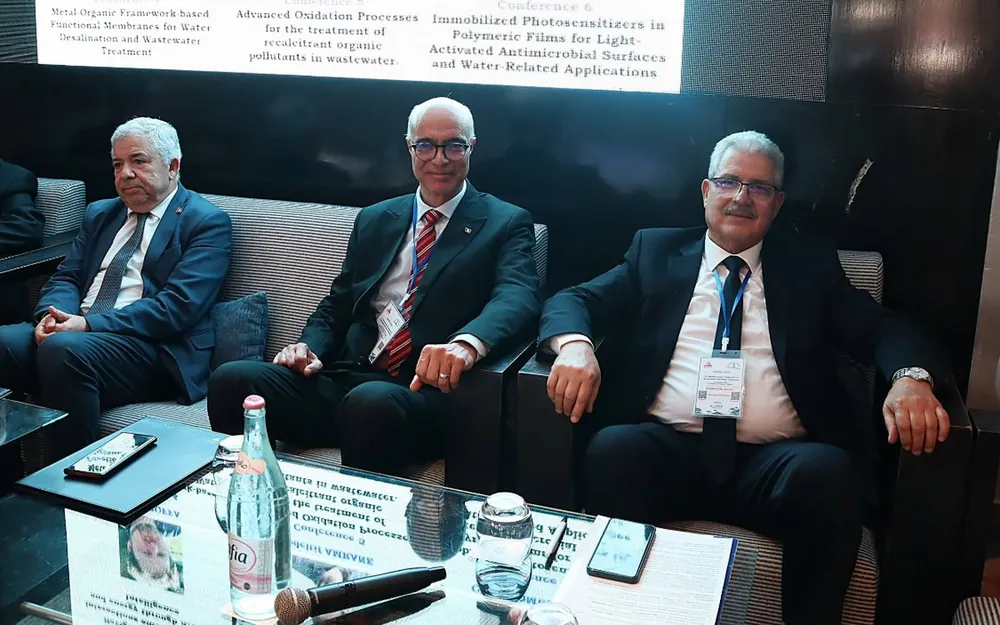
10th Mediterranean Conference on Water Treatment and Desalination
UTM, the Tunisian Desalination Association (TDA) and the European Desalination Society (EDS) held the 10th Mediterranean Conference on Water Treatment and Desalination (CMTDE) in Hammamet, under the auspices of the Ministry of Higher Education and Scientific Research and the Ministry of Agriculture. The conference focused on the links between water, energy, food and ecosystems. Experts from Spain, Italy, France and Denmark took part, together with representatives of industry and the Secretary of State to the Minister of Agriculture.
The announced programme covered sustainable desalination and water reuse, innovative membrane technologies, environmental impacts, digital solutions for water management, resilience to climate change, water governance, water and food security policies in the Mediterranean region, and case studies. The conference was addressed to researchers, experts, decision-makers and professionals of the water sector, with priority for doctoral students and teacher-researchers. The TDA is a non-governmental, non-profit scientific association, and its president, Prof. Béchir Hamrouni of the Faculty of Sciences of Tunis (FST), is the SDG 6 ambassador of UTM.
10th Mediterranean Conference on Water Treatment and Desalination (CMTDE), Hammamet · Photo: official UTM Facebook page
Workshop on water treatment technologies and strategies in Hammamet
The Tunisian Desalination Association organised the first edition of the workshop “Water and sustainability: treatment technologies and strategies” in Hammamet, with the Desalination and Water Treatment Laboratory of the Faculty of Sciences of Tunis (FST) and the EcoChemistry Laboratory of the National Institute of Applied Science and Technology (INSAT). The organisers placed the workshop in a context in which, according to data of the Ministry of Agriculture and Water Resources, the water available per Tunisian had fallen below 400 cubic metres per year, under the critical scarcity threshold of 500 cubic metres, a situation attributed to climate change and recurrent droughts.
The programme addressed desalination and the reduction of its energy cost through renewable energy, the reuse of treated water for irrigation and industry within a circular economy, and water governance and sustainable resource management policies at national and local levels. Experts, researchers and engineers from universities, public and private institutions, government bodies and international organisations active in the water and environment sectors were expected to take part.
Africa Water Forum and the UNESCO water innovation competition
UTM took part in the Africa Water Forum in Rabat, Morocco, a platform on which leaders and experts of the water sector discussed water security and sustainability. The forum brought together specialists from research, technology and industry and emphasised innovative strategies to address the growing water challenges of the continent, with a stress on collaborative research and development for the long-term resilience of resources.
Students of UTM participated in the international innovation competition organised by the UNESCO International Water Centre of Montpellier as part of the forum. The edition in which they took part gathered 74 international teams, eight of them representing Tunisia, compared with four Tunisian teams among 70 teams from Europe, Africa and North America in the previous edition. The growth in Tunisian participation reflected the engagement of students in innovation on water management and sustainability.
Wetland conservation and lagoon governance at FSEGT
The research laboratory on the economics of sustainable development, natural resources and agriculture (LEDDRNA) of the Faculty of Economic Sciences and Management of Tunis (FSEGT) organised the seminar “Institutional framework and financing mechanisms for wetland conservation in Tunisia”, with the Ministry of Environment, the Ministry of Agriculture, Water Resources and Fisheries, the United Nations Development Programme (UNDP) and the association ATRIADD. The objective was to examine strategies for strengthening the institutional framework and the financing mechanisms that support wetland conservation.
The seminar formed part of the GEL-GINTEL-BIZERTE project of the laboratory, within the EcoPact programme for the depollution of the Bizerte lagoon, launched by the National Agency for Environmental Protection and co-financed by the European Union. Another international seminar of the laboratory on the governance and management of Mediterranean lagoons, comparing Tunisia (Bizerte and Ichkeul), France and Italy, was opened by the Dean of FSEGT, Prof. Adel Boubaker, and by Dhekra Gharbi, head of the management unit of the EcoPact programme at the Ministry of Environment.
Institut Pasteur de Tunis, regional hub for wastewater surveillance
Institut Pasteur de Tunis (IPT), an establishment of UTM, announced its selection by the Africa Centres for Disease Control and Prevention (Africa CDC) as regional hub for wastewater and environmental surveillance (WES) in North Africa. The hub is meant to intensify environmental surveillance at sub-regional level by detecting pathogens in wastewater early, to improve early-warning systems and to strengthen the resilience of health systems against emerging threats.
The selection rests on the expertise of the Institute in the targeted monitoring of viruses and bacteria for public health and in genomics and bioinformatics, which serve to sequence and analyse the genetic data of infectious agents. The initiative falls within the One Health approach, which links human, animal and environmental health, and the press presented it as reinforcing the position of Tunisia as a key research actor in Africa.
A working meeting between Tunisia and Africa CDC, held at the Institute under the supervision of the Ministry of Health, examined how to create the regional pole for North Africa. The discussions covered environmental surveillance, early-warning and preparedness systems, skills networks, bioinformatics capacity, genomics and health research, and the exchange of expertise between research and health institutions.
WASTEWISE: continental wastewater surveillance and the role of IPT
WASTEWISE, the Wastewater Molecular and Genomic Surveillance in African Megacities project, is a three-year initiative led by Africa CDC, the African Society for Laboratory Medicine (ASLM) and the European Union, and implemented with the Health Emergency Preparedness and Response Authority (HERA) and the European Health and Digital Executive Agency (HaDEA) of the European Commission. It strengthens wastewater and environmental surveillance as an integrated early-warning system for epidemic-prone diseases, with pilots in Ethiopia, the Democratic Republic of the Congo and Kenya.
Institut Pasteur de Tunis (IPT) took part in the regional launch of the initiative through the kick-off meeting and inception workshop held in Addis Ababa, Ethiopia. A delegation of three researchers of the Institute contributed to the discussions, which defined the institutional framework for regional hubs, their governance and operational framework, their terms of reference, the technical, scientific and operational support they need, and the coordination mechanisms among regional hubs, African Union member states and Africa CDC. The Institute took part in its capacity as regional hub for North Africa.
Regional training on wastewater and environmental surveillance at IPT
Institut Pasteur de Tunis (IPT) hosted a regional training course titled “Wastewater and environmental surveillance in North African countries: site selection and sample collection strategies”, held within the EnSurPoV project. Participants came from the National Centre for Disease Control of Libya, the Institut Pasteur d’Algérie and the Directorate of Environmental Hygiene and Environmental Protection of Tunisia. Scientific sessions were combined with practical work, and a field visit to the Chotrana wastewater treatment plant allowed participants to practise site selection and sample collection under real conditions.
The Clinical Virology Laboratory of the Institute, the regional reference laboratory of the World Health Organization for poliomyelitis, also equipped itself with a technical platform entirely dedicated to environmental surveillance. Experts of the World Health Organization ran a specialised training course for its scientific teams on advanced techniques for detecting the silent circulation of polioviruses and enteroviruses in the environment, which strengthens the early-warning system. Both activities aimed to build regional capacity in environmental surveillance for tracking pathogens and protecting public health.
North Africa workshop on wastewater surveillance in Cairo
Institut Pasteur de Tunis (IPT) was among the organisations that gave presentations at the North Africa regional workshop on wastewater surveillance for environmental and public health, held in Cairo. The workshop was organised by the United Nations University Institute for Water, Environment and Health (UNU-INWEH) and the United Nations Environment Programme, in collaboration with the World Health Organization and its Regional Office for the Eastern Mediterranean, with the support of the European Health Emergency Preparedness and Response Authority. The Ministry of Health and Population of Egypt acted as host country.
Experts and policymakers from Algeria, Djibouti, Egypt, Libya, Morocco and Tunisia took part. The workshop explored how wastewater surveillance can support public health, environmental protection and ecosystem sustainability, and it aimed to build the capacity to establish and scale up surveillance programmes within national frameworks. Group discussions worked on a regional roadmap, and the closing discussions on country-specific planning identified practical steps to strengthen national frameworks, laboratory capacity and cross-sectoral coordination.
Take the SDG 6 report with you
The 2026 report for SDG 6 is a 9-page brochure with every activity and photograph from this page.