Green hydrogen, photovoltaic materials, bioenergy and urban energy systems shaped UTM's activities for SDG 7. The National Engineering School of Tunis hosted a conference with Bavarian partners, a congress on advanced materials and a colloquium on cities, the Faculty of Sciences of Tunis hosted an event on green hydrogen, and the Higher Institute of Applied Biological Sciences of Tunis hosts a bioenergy laboratory. Students took part in hackathons on climate and renewable energy, and solar installations and efficiency measures were put in place on campus.
Director of the Higher Institute of Biotechnology of Sidi Thabet
Our year for SDG 7
UNESCO Chair on waste, water and energy and the energy transition
The UNESCO Chair on waste, water and energy, hosted by the National Engineering School of Tunis (ENIT) and carried by its LAMSIN laboratory of mathematical and numerical modelling in the engineering sciences, places the energy transition beside water management and waste treatment. The promoters of the chair refer to the need to increase the energy capacity of Tunisia through the integration of renewable and green energy and to transform research and innovation into action in the field; their diagnosis of the national context notes the lack of autonomy in fossil energy and the small contribution of renewable energy. ENIT and the University of Sousse were each honoured with a UNESCO chair, and the ENIT chair covers water, waste and energy; according to the press, Tunisia counts seven UNESCO chairs across six institutions.
The chair brings together researchers, decision-makers and civil society to design a model of sustainable cities adapted to the Tunisian way of life. One of its work packages concerns the rehabilitation of Tunisian cities in order to create a model city for sustainable development, with teams from ENIT, the National Institute of Applied Science and Technology (INSAT), the National School of Architecture and Urbanism and the Narbonne laboratory of the French National Research Institute for Agriculture, Food and Environment (INRAE). A presentation by a LAMSIN researcher linked the chair to several Sustainable Development Goals, among them goals 3, 4, 6, 7, 9, 11, 12, 13 and 17, and to teaching at several levels, from initial to continuing and professional training.
The partnership framework presented by its promoters includes, in the North, the REUSE and TREASURE networks of INRAE and the UNESCO water centre in Montpellier and, in Tunisia, the national sanitation office, the national water utility, ministries and elected representatives. The chair also serves as the framework for scientific events on these themes, among them a multidisciplinary colloquium on cities and an international conference on sustainable and resilient cities, which examine the nexus of water, waste and energy.
Research laboratories working on energy at UTM
UTM relies on several research laboratories for work on energy. At the National Engineering School of Tunis (ENIT), the Materials, Optimisation and Energy for Sustainability Laboratory (LR11ES16), the Photovoltaic and Semiconductor Materials Laboratory (LR20ES05) and the Energy and Environment Laboratory (LR21ES09) carry research on energy-related topics, as their names indicate. At the Faculty of Sciences of Tunis (FST), the Energetics and Thermal and Mass Transfers Laboratory (LETTM, LR01ES07) works on energetics and on heat and mass transfer.
ENIT also hosts micro-grid energy units used for research and training. One of them, SMARTNESS, is a smart micro-grid platform with an energy management system, powered by photovoltaic solar panels, which supports decentralised renewable generation and research on energy management systems, blockchain applications and virtual power plants. At the Higher Institute of Applied Biological Sciences of Tunis (ISSBAT), the BIOTEC H2 joint laboratory adds a bioenergy strand to this research base.
BIOTEC H2: biohydrogen and methane from agri-food by-products
The BIOTEC H2 International Joint Laboratory, hosted within the Higher Institute of Applied Biological Sciences of Tunis (ISSBAT), focuses on the production and storage of biohydrogen and methane from fermentable agri-food by-products. It brings together Tunisian institutions, among them ISSBAT, and French research units, with the aim of developing efficient bioprocesses that convert organic waste into clean energy carriers.
ISSBAT contributes an anaerobic dark fermentation platform that consists of two automated fermentation lines of two litres each and one fermenter of ten litres. The platform serves the development of bioprocesses that turn organic waste into clean energy carriers, and it places bioenergy production from waste among the research themes of UTM for affordable and clean energy.
AMINNOV: international congress on advanced materials at ENIT
The Photovoltaic and Semiconductor Materials Laboratory (LPMS) of the National Engineering School of Tunis (ENIT) organised AMINNOV, the first international congress on innovation in advanced materials, at ENIT under the patronage of the school and of UTM. The congress was designed as an interdisciplinary exchange platform that brings together researchers, industry representatives and students to discuss innovations in functional, intelligent and sustainable materials. The programme combined plenary talks, technical presentations, poster sessions and workshops. The congress was organised around four symposiums: synthesis and characterisation of advanced materials, advanced materials for sensors, computational and modelling approaches, and artificial intelligence for advanced materials. Announced topics included artificial intelligence applied to materials, nanotechnologies, energy storage, sensors and photovoltaic systems.
Conference on New Energy Technologies at ENIT
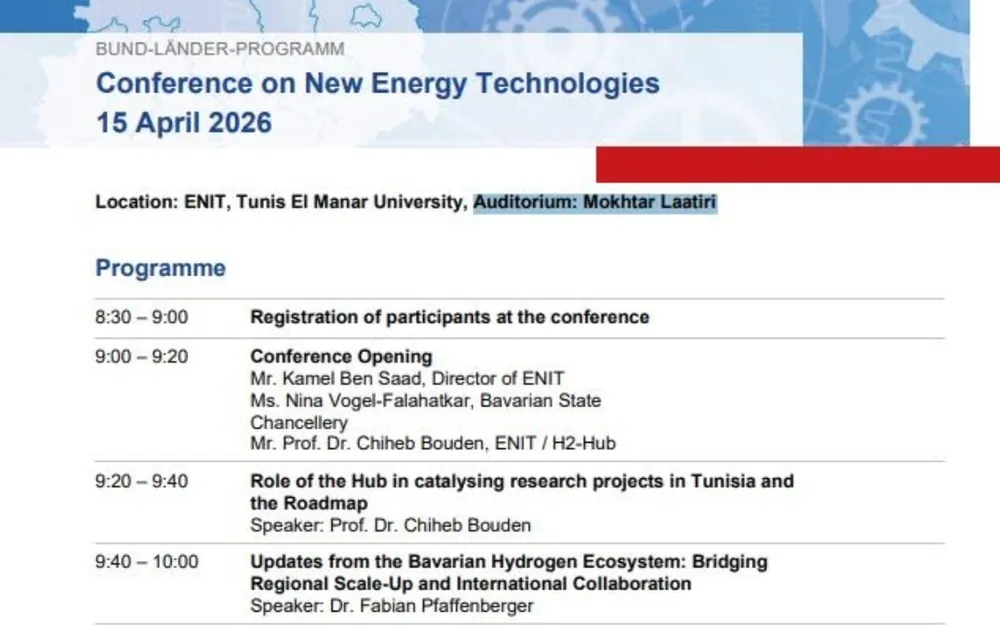
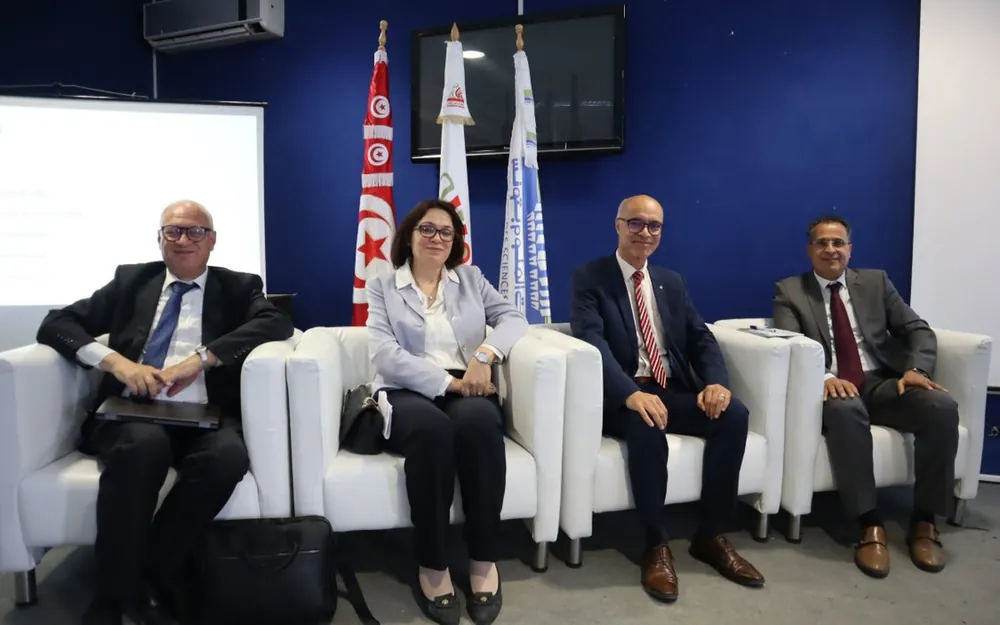
The National Engineering School of Tunis (ENIT) hosted the Conference on New Energy Technologies in the Mokhtar Laatiri auditorium, under the Bund-Länder programme of German federal and state cooperation. The conference was opened by the Director of ENIT, Kamel Ben Saad, by Nina Vogel-Falahatkar of the Bavarian State Chancellery and by Prof. Chiheb Bouden of ENIT and of the Tunisian-Bavarian Green Hydrogen Hub. Prof. Bouden presented the role of the Hub in catalysing research projects in Tunisia and its roadmap, and Dr Fabian Pfaffenberger presented developments of the Bavarian hydrogen ecosystem and its international collaboration. The conference thus combined the Tunisian view of the Hub with an overview of the Bavarian partner side.
The Tunisian-Bavarian Green Hydrogen Hub is hosted at ENIT as the first hub of its kind in the Tunisian-Bavarian partnership. It serves as a platform for exchange and training that promotes research and the development of advanced technologies related to green hydrogen, strengthens scientific and technological cooperation, increases exchanges of experience and partnerships, and offers training and skills development to professionals.
The Hub was mandated under the Bund-Länder programme and belongs to a Tunisian-Bavarian programme for green hydrogen technology and innovation that complements a German programme implemented by the Deutsche Gesellschaft für Internationale Zusammenarbeit (GIZ) with the Tunisian Ministry of Industry, Mines and Energy. The programme also plans strategic partnerships between scientific and industrial research institutions and the empowerment of Tunisian and Bavarian women working in the sector.
According to the reports of UTM, the Hub contributes to shaping the strategy of Tunisia to become a regional frontrunner in green hydrogen and to make use of its renewable energy resources, and it promotes knowledge transfer, capacity building and the development of sustainable energy systems between Tunisia and Bavaria. ENIT also collaborated in the regional Green Hydrogen Camp held in Tunis, and one of its professors introduced green hydrogen into engineering training.
Green hydrogen: a pillar of the energy transition
The Faculty of Sciences of Tunis (FST) hosted the event “Green hydrogen: a pillar of the energy transition”, organised by the association OSIRIS with the Centre for Research and Energy Technologies (CRTEN) and the faculty. OSIRIS is a scientific association for sustainability that had already organised with UTM, at the same faculty, a screening of the documentary “Before the Flood” followed by a round table on climate change.
Green hydrogen is produced by water electrolysis powered by renewable energy and is regarded as a key pathway towards industrial decarbonisation. When produced in this way it emits no greenhouse gases and offers flexibility in storage and distribution, which gives it potential for the domestic energy transition of Tunisia and for export markets, according to the climate reports of UTM.
ENIT collaborated in the third Green Hydrogen Camp, held under the theme “From theory to action” and organised by the Med-GEM network at the École Polytechnique de Tunisie in Sidi Bou Saïd. The camp combined a summer university and a regional hackathon for students from the European Union and the Southern Mediterranean, who studied hydrogen production, storage, distribution and applications in energy, transport and industry alongside experts and mentors.
The camp was funded by the European Union and the German Federal Ministry for Economic Cooperation and Development (BMZ) through the H2Vert.TUN project, “Green hydrogen for sustainable economic growth and a decarbonised economy in Tunisia”, which is implemented by the Tunisian Ministry of Industry, Mines and Energy and the German development agency GIZ. It gathered thirty experts, ten from the European Union and the MENA region and twenty from Tunisia. The first two camps had been held in Morocco and Lebanon, and the third edition was open exclusively to participants from the European Union and the Southern Mediterranean, with the aim of deepening the knowledge of students in renewable hydrogen technologies and of encouraging cross-border collaboration and innovation.
Green hydrogen and sustainable cities in civil engineering training
Prof. Chiheb Bouden of ENIT proposed and coordinated an exploration of “Green hydrogen and sustainable cities” for the opening week of the second-year civil engineering programme. The session presented green hydrogen as a foundation of urban sustainability and as a pivotal technology for carbon neutrality, because it can decarbonise sectors that resist electrification and can store surplus renewable energy. The vision developed for the students was that of cities powered by clean transport, energy-efficient infrastructure and resilient energy systems. The session brought topics of the energy transition into engineering training at ENIT, the school that hosts the Tunisian-Bavarian Green Hydrogen Hub.
International colloquium “Science & Villes”
ENIT, in partnership with the UNESCO Chair on water, waste and energy, organised the international multidisciplinary colloquium “Science & Villes”. The colloquium addressed sustainable urban development through an integrated and systemic approach, with a focus on urban energy systems and the energy transition, on low-carbon and resilient urban solutions, and on the water-waste-energy nexus as a framework for sustainable cities. The discussions presented urban sustainability as a complex system that requires coordinated action supported by scientific research, policy-making and local stakeholders. The multidisciplinary programme engaged researchers, students, policymakers and practitioners, and it illustrated the capacity of UTM to convene scientific forums aligned with global sustainability objectives and clean energy priorities.
UTM President at the International Conference on Energy and Applications
The President of UTM, Moez Chafra, took part in the International Conference on Energy and Applications (ICEA25) at the University of Djibouti. The participation formed part of the international academic cooperation of UTM and of its engagement in research fields related to sustainable energy. The report of UTM presents it as a contribution to global knowledge exchange and to the institutional partnerships of the university within the international higher education and research community.
ClimAdapt Hack: geospatial data and AI for climate and energy challenges
Students and young innovators of UTM took part in ClimAdapt Hack, a nationwide innovation event that brought together participants from across Tunisia. The hackathon focused on developing real-world solutions that use geospatial data and artificial intelligence to address challenges of climate and energy. The challenges covered energy resilience and smart-grid management, with the optimisation of renewable energy integration and distribution; climate-smart infrastructure, with adaptive urban systems that respond to environmental risks; and sustainable territorial and urban planning, using data-driven tools for land use, transport and resource allocation in line with climate goals. The programme combined collaborative problem-solving, expert mentoring and iterative prototyping, and it drew on engineering, data science, environmental science and urban design.
Digital solutions for renewable energy
Batna 2 University in Algeria hosted the second edition of the cross-border hackathon of Tunisian, Algerian and Libyan universities, devoted to digital solutions for renewable energy. UTM took part in the organisation on behalf of the Tunisian universities. The first edition of the hackathon, organised in Tunisia, was devoted to the circular economy. At the second edition, held in Algeria, Tunisian and Algerian teams worked on digital tools for renewable energy, which brought student cooperation between neighbouring countries to the energy sector.
UTM-Innov: student ventures including energy projects
The third edition of UTM-Innov, the innovation competition of UTM organised through its Student Entrepreneur Hub (P2E-UTM), culminated in a final at ENIT. The competition aims to encourage innovation and to help students and young graduates turn their ideas into sustainable economic and social projects. About ninety students and graduates took part and some forty projects were presented, with training and coaching offered in partnership with the Fondation Tunisie pour le développement and with legal, logistic and financial support.
Sixteen teams reached the final, eleven of them at the stage of an idea and five with a prototype. The projects covered health, biotechnology, clean agriculture, energy, education, services, medical research, engineering applications and environmental issues. The jury consisted of experts from the Tunisian and Quebec entrepreneurial ecosystems and assessed innovation, feasibility and economic and social impact. The organising committee was chaired by Mouna Marrakchi.
Photovoltaic plants and energy efficiency at ENIT
ENIT has equipped its buildings with photovoltaic plants. Within the MEDREC project, a plant of 71 kWc (kilowatt-peak) was installed on the roof of the Osman El Bahri Tower. The school also joined the Energy Transition in Public Institutions (TEEP) project of the National Agency for Energy Conservation (ANME), within which solar panels with a capacity of 146 kWc were installed on the fourth level of the school. According to the report of UTM on ENIT, the two installations together cover approximately 48 percent of the electricity needs of the school.
TEEP is a programme financed by the German development bank KfW that promotes energy efficiency and autonomous solar photovoltaic production in public buildings. It aims to equip public establishments with about 30 MWc of grid-connected photovoltaic capacity and to reach energy savings of about 80 ktoe per year, and its pilot phase equipped educational institutions with autonomous photovoltaic systems of about one megawatt in total. The programme is financed with an investment of 160 million Tunisian dinars, and later tenders cover efficient lighting for 89 public establishments, the renovation of air conditioning, energy-efficiency studies and the installation of metering and monitoring systems. Under the programme, ENIT planned to replace all halogen bulbs and fluorescent tubes by LED equivalents and old air conditioners by energy-efficient class 1 models. The school also organises annual awareness days: LABEL ENIT, devoted to cleanliness and aesthetics on campus and in its surroundings, and GreENIT, devoted to the importance of trees for the environment. Both aim to foster an environmentally responsible community among students, faculty and staff.
Take the SDG 7 report with you
The 2026 report for SDG 7 is a 8-page brochure with every activity and photograph from this page.