The University of Tunis El Manar (UTM) and its establishments contributed to SDG 8 through student entrepreneurship, graduate employability, partnerships with banks, financial regulators and municipalities, and measures for the well-being of staff. The student entrepreneur hub P2E-UTM, the UTM-Innov competition and the innovation and technology hub PUIT supported young innovators. Faculties and institutes revised programmes, opened internship and professional training routes, and organised scientific events on insurance, finance, taxation and labour law.
National Student Entrepreneur Status: calls for applications and awareness sessions
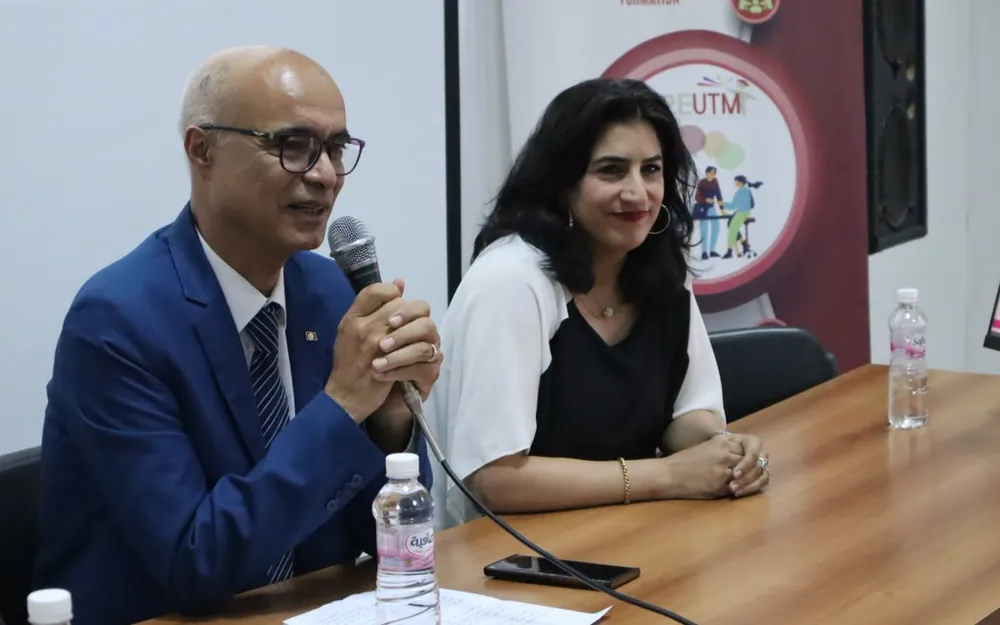
The Student Entrepreneur Hub of UTM (Pôle de l’Étudiant Entrepreneur, P2E-UTM) launched a call for applications for the second cohort of the National Student Entrepreneur Status (SNEE). The status is the regulatory framework defined by the Ministry of Higher Education and Scientific Research to consolidate student entrepreneurial initiatives. It is granted after a selection process to students who carry an innovative project idea or wish to create a company during their studies, at any level and in any specialty, and it offers academic advantages, training, personalised support and networking with experts and partners from the socio-economic world. The hub’s antenna at the Faculty of Medicine of Tunis held an open information session on the status, in which a student entrepreneur from the first cohort described the benefits from experience.
The Faculty of Medicine of Tunis also organised a masterclass entitled “Entrepreneurship in the health field”, with registration through an online form, as part of its series of masterclasses. P2E-UTM further opened a call for a fourth cohort: any UTM student can apply, alone or in a team of up to four members, and the finalists receive the National Student Entrepreneur Status, which gives access to the training, mentoring and networking of the programme.
P2E-UTM Demo Days for the second and third cohorts
The Demo Day of the second cohort of P2E-UTM took place in the Mokhtar Laatiri hall of the National School of Engineers of Tunis (ENIT). The event closed the programme of the cohort that had been recruited through the call for applications circulated in the establishments of UTM. The Faculty of Medicine of Tunis relayed the event on its website through a presentation document of P2E-UTM.
The Demo Day of the third cohort was hosted by the Faculty of Medicine of Tunis. After several months of training, mentoring and support, student start-ups pitched their projects to stakeholders of the innovation and entrepreneurship ecosystem, and the university gave prizes to the strongest projects. Students who completed the stages of the programme received the National Student Entrepreneur Status. UTM also honoured Prof. Amel Saffar for leading the training of trainers of P2E-UTM.
Projects from the three cohorts of the hub were selected to pitch in the “Young and Student Entrepreneurs” category of the Phare de l’Entrepreneuriat: MIR-ACLE Biotech, Diplomap and Ulysse. An alumna of the first cohort, representing MIR-ACLE Biotech, won the category award. The hub thanked ACCEDE Internationale, the Agence universitaire de la Francophonie (AUF) Afrique du Nord, The Dot and Africalink for their support.
UTM-Innov: final of the third edition of the innovation competition
UTM organised the final of the third edition of the UTM-Innov competition, dedicated to innovative initiatives and entrepreneurship, at the National School of Engineers of Tunis (ENIT). The competition belongs to the activities of P2E-UTM. It aims to encourage an innovation mindset among students and young graduates and to help them turn ideas into sustainable economic and social projects. About 90 students and graduates from the establishments of UTM took part and presented roughly 40 projects in health, biotechnology, clean agriculture, energy, education and services.
Participants received training and coaching through workshops run with the Fondation Tunisie pour le développement, together with legal, logistical and financial support. A jury of experts from the Tunisian and Quebec entrepreneurial ecosystems assessed the projects on innovativeness, feasibility, and economic and social impact, and selected 16 teams for the final: 11 at the idea stage and 5 with prototypes. The president of the organising committee, Mouna Marrakchi, explained that the competition seeks to help projects grow from the local to the international level. The finalists presented to the jury, followed by an awards ceremony.
PUIT-UTM: innovation and technology hub, start-up support and international interns
The University Innovation and Technology Hub (Pôle Universitaire d’Innovation et de Technologie, PUIT) of UTM was inaugurated at the National School of Engineers of Tunis (ENIT) as a consortium carried by UTM, the Agency for the Promotion of Industry and Innovation (APII) and the accelerator U-Accelerator. Its mission is to turn scientific research into marketable innovations, to develop academic entrepreneurship and to facilitate technology transfer to industry, in line with the United Nations Sustainable Development Goals and Tunisia’s National Innovation Strategy 2030. The hub is directed by Noamen Rebai. Its platform ValoTechLab connects technology providers, such as laboratories, start-ups and universities, with companies, experts and investors.
PUIT opened a rapid prototyping laboratory equipped with industrial 3D printers, laser cutters and computer-aided design stations, to speed up the development of projects by students, doctoral candidates and incubated start-ups. It also launched Tech4Impact, a programme that supports young researchers and entrepreneurs in developing technological solutions with a strong social impact. PUIT-UTM and the organisation ATERA, partners within an existing cooperation, hosted twelve international interns from Italy, Romania, Algeria, Morocco, Egypt and Turkey, together with AIESEC Manouba.
UTM and its innovation hub also took part in a partnership with the research valorisation agency ANVREDET, the Caisse des Dépôts et Consignations, the accelerator U-Accelerator and the Arab Information and Communication Technologies Organization (AICTO). The partnership creates a direct support channel for researchers and students who launch technology and innovation start-ups, with structured guidance, mentoring, expertise from established industry players and networking, so that founders can obtain funding, strategic advice and contacts to establish and scale their companies. It reinforces the action plan of PUIT.
HacKa2’OOUN: student hackathon on entrepreneurship and community enterprises
UTM and the Office of University Services for the North (OOUN) prepared the second edition of the student hackathon HacKa2’OOUN. A working session between the President of UTM, Moez Chafra, and the director general of OOUN addressed the date and venue, the general programme and the coordination with speakers and logistical partners, with the aim of mobilising as many students as possible. The first edition took place at the City of Science in Tunis and gathered 60 students. It focused on entrepreneurship and the creation of community enterprises serving the Sustainable Development Goals, and it was organised by OOUN in partnership with the student initiative hub of the University of Manouba, under the supervision of the Ministry of Higher Education and Scientific Research.
Fish Living Lab: participatory innovation for fisheries in the Bizerte lagoon
The research laboratory on the economics of sustainable development of natural resources and agriculture (EDDRNA) of the Faculty of Economics and Management of Tunis (FSEGT) began a collaboration with the association JCI Bizerte. The first activity of the project Gel-gintel, a living laboratory called “Fish Living Lab”, aims to stimulate value-added innovation in the fishing and shellfish-farming sectors of Bizerte. It consisted of a participatory workshop on the analysis of problems and the diagnosis of the current state of fishing in the Bizerte lagoon, held in the municipality of Menzel Abderrahmane.
Fishers, shellfish farmers, farmers and other stakeholders of the lagoon took part, together with representatives of the two fishing unions, of regional and national authorities in charge of fisheries, agriculture and environmental protection, of the chamber of commerce and of local municipalities. The workshop identified the nature of the relations among stakeholders, whether good, conflictual or non-existent, and the main challenges of artisanal fishing in the lagoon. The laboratory noted the absence of industrial companies. Its results serve as the starting point for mobilising researchers in an innovation process that answers the challenges of artisanal fishing and shellfish farming.
AI-based platform linking students, companies and the university
The President of UTM, Moez Chafra, presented a digital platform based on artificial intelligence that links students, companies and the university. The platform, accessible through the website of PUIT-UTM, lets students browse academic programmes, consult internship, end-of-study project and job opportunities, and find the laws and regulations that govern the path to professional integration. Its matching functions propose opportunities according to skills, aspirations and market needs, while companies see the human resources trained by the university and can identify profiles that fit their sectoral needs. UTM presented the platform as part of its effort to modernise services and strengthen graduate employability, against a national unemployment rate of 24.9 percent among higher-education graduates reported by the National Institute of Statistics (INS).
UTM also digitised the authentication of university certificates, grade reports and other pedagogical documents that graduates must present to foreign authorities, after a ministerial notice entrusted universities with this task. An online platform lets applicants create an account, submit their requests and follow the procedure for documents issued by UTM and its establishments, which allows the service to be provided within reasonable time.
FSEGT Employment Fair with banks and financial institutions
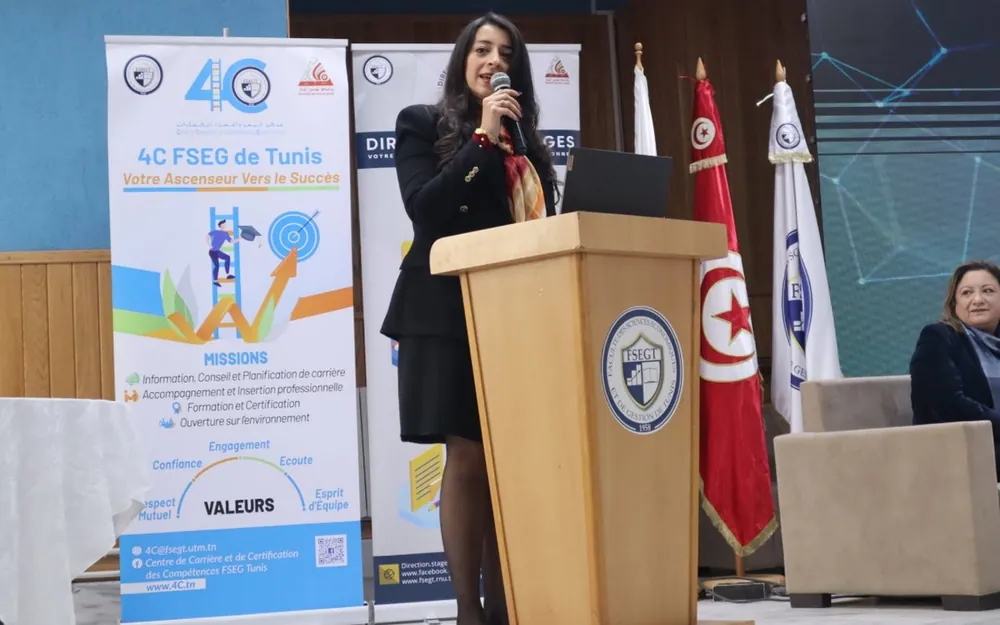
The Faculty of Economics and Management of Tunis (FSEGT) held its fifth Employment Fair on the theme “Pivoting your career with AI and sustainability”, with the participation of banks and financial institutions. The fair brought students and future graduates together with bank executives at a time when artificial intelligence is reshaping the labour market. Discussions explored new career prospects in which data skills and human skills must converge.
During the fair, the Arab Tunisian Bank (ATB) signed an internship agreement with officials of the faculty. The agreement formalises a long-standing collaboration and gives students a direct route into the professional world. The Director General of ATB, Riadh Hajjej, addressed the future graduates and encouraged them to build hybrid skills for a constantly changing environment and to pursue excellence in a financial sector that is being transformed.
Graduate survey and soft-skills training for job seekers
The Observatory of UTM invited students and graduates of the university to answer an online survey evaluating academic training and professional integration. The survey belongs to the strategy of continuous improvement of the quality of programmes, of a closer match with the labour market and of a higher employability rate among young graduates. Responses are confidential and used for statistical purposes only. Respondents receive priority access to the complementary training that UTM organises to support integration, and they join the UTM alumni network. The alumni report of UTM states that 3,600 alumni were contacted and 2,450 responded, a response rate of 68.1 percent.
UTM and the Centre d’Orientation et de Reconversion Professionnelle (CORP) offered students and graduates free training in soft skills and job search, in two series of sessions. CORP is a programme of the Tunisian-German Chamber of Industry and Commerce (AHK Tunisie) that provides professional orientation, career retraining, employment events and soft-skills training covering professional communication, teamwork, adaptability and job-search techniques.
FSEGT programmes revised to match labour-market needs
Within the accreditation process of UTM, the Faculty of Economics and Management of Tunis (FSEGT) revised its existing curricula to integrate new skills in finance, banking, insurance, international trade, marketing, management, accounting and business intelligence. The university stated that the aim is to align programmes with developments in the disciplines and with changing job-market demands. The faculty also introduced new tracks, among them economic intelligence and evaluation in economic sciences, human resources management in management sciences, and e-business in management informatics. A pilot bachelor’s degree in Business and Economic Analytics is taught entirely in English, follows international academic standards and targets the strongest incoming baccalaureate holders. The faculty holds certification to ISO 21001:2018, the standard for management systems of educational organisations, which frames the quality management of its training and services.
ISI integrated preparatory cycle and the ISSBAT–ISI bachelor’s degree BioXplore
UTM launched an integrated preparatory cycle in computing at the Higher Institute of Computer Science (ISI), a five-year track that combines a two-year preparatory cycle and a three-year engineering cycle. The first year is a common core, the second offers progressive orientation towards computer science or computer engineering, and the last two years specialise in software engineering, AI and data science, embedded systems and the Internet of Things, or intelligent networks and services. The track includes four progressive internships, described as associative, discovery, worker and engineer internships, which UTM presented as a way to build skills gradually and to match the needs of the digital market.
The Higher Institute of Applied Biological Sciences of Tunis (ISSBAT) and ISI launched the national bachelor’s degree BioXplore, “Bioinformatics and Exploration of Living Data”, which combines life sciences, computing, data science and artificial intelligence. The communiqué described it as the first national bachelor’s degree awarded through co-diplomation between two establishments of UTM. It aims to give students competence in biology, computing and data analysis and to prepare them for emerging jobs, citing employability potential in digital health, biotechnology, genomics, precision agriculture and biomedical research.
Cybersecurity analyst certificate for professionals and job seekers at ISI
UTM and the Conservatoire national des arts et métiers (Cnam, France) offer a certifying course for the cybersecurity profession, the “Certificat de compétence Analyste en cybersécurité”, delivered at the Higher Institute of Computer Science (ISI). Courses take place one day a week, a schedule adapted to working professionals, and are followed by a four-month internship in a company. They are taught by academic experts and professional speakers. Admission requires at least two years of higher education in computing or in a scientific or technical field, and priority is given to higher-education graduates who are looking for work and wish to retrain towards computing professions. Applications include a CV, a cover letter, copies of diplomas from the baccalaureate onward and transcripts.
The certificate prepares analysts whose main role is to oversee the IT-security activities of companies: crisis management, supervision of systems and networks, advice on security practices, implementation of new security technologies and development of security strategies. The Cnam delivers the certificate. Registration fees cover the academic training and the internship and can be paid in instalments. The offer has been repeated for successive intakes.
Joint professional doctorate with a Japanese university and partner companies
UTM and the University of Electro-Communications (UEC, Tokyo) signed an academic cooperation agreement that provides for the first joint professional doctorate between Tunisia and Japan, in electronic communications engineering and, more broadly, industrial engineering. According to the President of UTM, Moez Chafra, each doctoral student is accompanied by a partner company, in order to promote applied research and technology transfer to Tunisian industry. The agreement also strengthens exchanges of expertise and scientific cooperation between the researchers and students of the two institutions. The director of the National School of Engineers of Tunis (ENIT), the director of the doctoral school and the dean of the Faculty of Sciences of Tunis attended the signing ceremony.
Partnerships between banks and UTM establishments
BNA Bank and the Faculty of Economics and Management of Tunis (FSEGT) signed a partnership agreement at the headquarters of the bank. The agreement is part of efforts to strengthen cooperation between the university and the business world and of the commitment of the bank to the employability of young graduates and to skills development. Its stated objectives include promoting a culture of sustainable development and social engagement, increasing the sharing of expertise between academia and the professional sector, supporting financial inclusion, exposing students to banking realities, helping to improve the infrastructure and learning conditions of the faculty, and bringing students closer to the professional world to ease their gradual entry into the job market.
A commercial bank also signed two cooperation agreements, one with the National School of Engineers of Tunis (ENIT) and one with FSEGT, in the presence of the Vice-President of UTM, Nesrine Zoghlami, the Director of ENIT, Kamel Ben Saad, and the Dean of FSEGT, Adel Boubaker. These agreements extend to the engineering school and to the economics and management faculty the cooperation between UTM establishments and the banking sector, which also includes the internship agreement signed with the Arab Tunisian Bank.
MBA in audit, management control and finance with ICS Bégué
The Faculty of Economics and Management of Tunis (FSEGT) and ICS Bégué, a Paris-based school specialised in accounting, management, audit and finance, signed a strategic partnership agreement to offer an MBA in audit, management control and finance to Tunisian and international students. The signing took place at FSEGT in the presence of the Dean, Prof. Adel Boubaker, the Vice-Dean, Donia Smaali Bouhlila, and the director of ICS Bégué, Valérie Piot. The agreement was concluded for five years and can be renewed.
The two-year programme is open to holders of a qualification at the level of three to five years of higher education and is offered to more than 50 Tunisian students each year, with the possibility of work-study in the fifth year. It combines academic and professional skills, case-study pedagogy with interventions by sector professionals, and a diploma delivered by ICS Bégué in Paris, in line with the references of accounting expertise and management control. The partners presented the agreement as a step in international cooperation for higher education and for the employability of young graduates.
Partnership between FSEGT and the National Federation of Tunisian Municipalities
The Faculty of Economics and Management of Tunis (FSEGT), represented by its Dean, Adel Boubaker, and the National Federation of Tunisian Municipalities (FNCT), represented by its president, Fathi Mejri, signed a partnership agreement to support municipal action through the exchange of expertise. It provides internships for students within Tunisian municipalities and the development of local, sustainable solutions in municipal financial management, economic development and public innovation. The agreement is linked to the acceleration of local reform, in which local authorities are expected to play a central role in inclusive and sustainable development.
The planned activities include joint research and training projects and workshops, with students directly involved in designing and implementing local solutions. The partners aim to improve employability, encourage urban entrepreneurship and update municipal skills, as well as to improve the quality of local public services and the resilience of territories. FNCT described the agreement as a framework for the exchange of expertise among teacher-researchers, students and municipalities and as a step towards opening municipalities to scientific institutions.
Faculty of Law and Political Science and the Conseil du Marché Financier
The Conseil du Marché Financier (CMF) took part in organising, with the Faculty of Law and Political Science of Tunis (FDSPT) and its Laboratory of Legisprudence and Jurisprudence, the national scientific colloquium on Law No. 94-117 on the reorganisation of the financial market, thirty years after its promulgation. Academics, CMF executives, experts and sector professionals discussed how to modernise the legal framework of the financial market to accompany economic and digital transformations and to strengthen the attractiveness of the market. The Dean of the faculty and the President of the CMF board opened the colloquium. The latter stressed the dialogue between university and public institutions and referred to the participatory revision of the rules on prospectuses, meant to encourage public offerings of securities as a means of financing companies while ensuring transparency.
The laboratory then signed a partnership agreement with the CMF, which sets a framework for scientific and technical cooperation in research, training and the exchange of expertise. It covers joint studies, seminars, conferences and study days, applied research projects, and the compilation and dissemination of CMF case law. Researchers, doctoral students and students gain access to the professional expertise of the CMF in market regulation and supervision. The themes include financial transparency, investor protection, risk management, financial innovation and sustainable finance.
FIERIT: scientific event on the future of insurance at ENIT
The National School of Engineers of Tunis (ENIT) organised the scientific event “Future of Insurance: Emerging Risks and Innovative Tools” (FIERIT) in its amphitheatres. The first day consisted of scientific presentations by academic and industry researchers, and the second day of two thematic panel discussions and a hackathon. Topics included emerging risks such as climate change, cyber-attacks, longer life expectancy and new mobility models, and technological and mathematical innovations such as big data and generative AI for pricing and fraud detection, smart contracts for claims management, advanced actuarial models for extreme events and parametric insurance.
Invited speakers came from ENIT and the Faculty of Sciences of Tunis, from the Conservatoire national des arts et métiers, Sorbonne Paris North University, ENSAE Paris and Aix-Marseille University, and from the University of Lisbon. The panels dealt with the Tunisian insurance sector facing emerging risks and the data revolution, and with modelling challenges linked to emerging risks. They brought together professionals from reinsurance, consulting and technology companies and academics.
Colloquia at the Faculty of Law and Political Science on labour law and taxation
The doctoral school of the Faculty of Law and Political Science of Tunis (FDSPT) held a colloquium on sixty years of the Labour Code, the national text that governs employment relations. The topic belongs to a national debate on the revision of the code, for which the Council of Ministers examined a draft law amending certain provisions. The faculty also presented two new labour-law books: “Lessons in Labour Law, volume 1” by Dr Fadwa Gahwaji and “Labour law: individual relations” by Prof. Sana Souissi.
The Laboratory of Constitutional, Administrative and Financial Sciences (LASCAF) of the faculty partnered with the Tunisian Observatory of the Economy for the international colloquium “International tax cooperation in light of the new international tax order”. The first day addressed the emerging international tax order, the respective roles of the Organisation for Economic Co-operation and Development (OECD) and the United Nations, and the challenges and reform prospects of tax systems in North African countries. The second day dealt with tax evasion, the digital economy and the financing of equitable development, with panels on adapting international tax-law standards, taxing the digital economy, dispute resolution and the relation between bilateral tax treaties and development goals.
Staff recognition, social support and flexible working arrangements
The Faculty of Economics and Management of Tunis (FSEGT) held a Gratitude Day to honour its staff. The event belongs to the wider practice of UTM of involving administrative and support staff in university events and ceremonies, which the university considers a way of strengthening the sense of belonging, morale and teamwork. Periodic development sessions also let administrative staff explore new tools, such as the new university management software, through hands-on training, exchange of feedback and practice of its usability.
The UTM Employee Association for Non-Academic Staff provides financial assistance to eligible non-academic staff at Eid al-Fitr, Eid al-Adha and the back-to-school season, and organises recreational trips for staff and their families. A mediation committee offers a confidential platform for conflict resolution. The university gives access to psychologists and operates the University Medical Center “Tawhida Ben Cheikh” at the Farhat Hached campus, with general practitioners, dentists, psychologists and midwives.
The policy of UTM on remote and condensed work lets academic staff request remote work or a condensed schedule, and administrative staff request a condensed schedule. Up to 20 percent of the allocated working time can be worked remotely, subject to departmental needs, teaching duties and the approval of the supervisor. The university provides digital tools and training, expects staff to remain reachable during working hours and collects staff feedback periodically to review the arrangements.
Take the SDG 8 report with you
The 2026 report for SDG 8 is a 11-page brochure with every activity and photograph from this page.