The University of Tunis El Manar (UTM) and its establishments strengthened research, innovation and infrastructure through a digital platform for research structures, an innovation and technology hub with new institutional and financial partners, pilot facilities in biotechnology and vaccine research, international conferences, information sessions on European funding, and agreements with universities in Asia, Europe, Africa and North America. The entries follow that sequence, from research structures to partnerships.
Research Structures Day and a digital platform for research laboratories
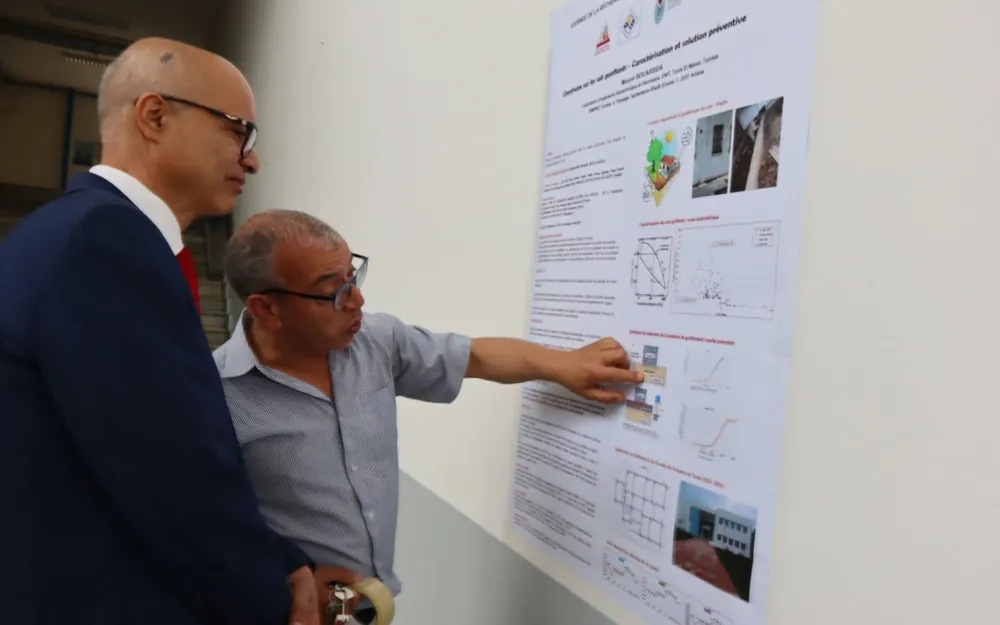
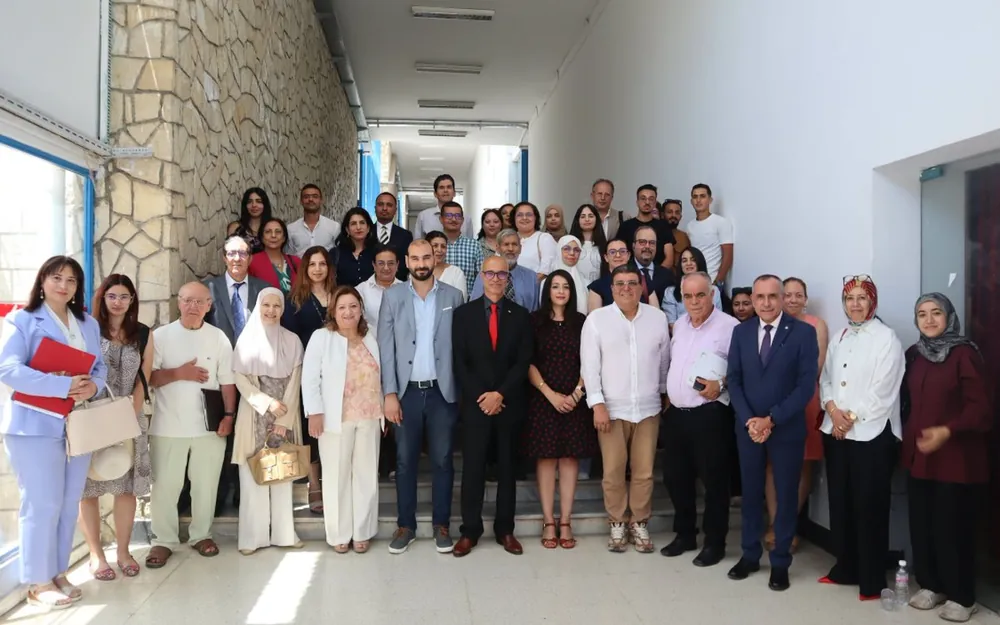
The National Engineering School of Tunis (ENIT) hosted the Research Structures Day, organised by UTM. The chief of staff of the Minister of Higher Education and Scientific Research, Prof. Mourad Belassoued, and ENIT Director Kamel Ben Saad attended, and UTM laboratories presented their work on posters. The day was devoted to the official launch of a digital platform for managing and steering research structures, presented as part of UTM’s strategy to modernise scientific research and improve its governance.
According to press coverage of the launch, the platform simplifies the administration of research projects, tracks research work and the development of researchers’ skills, and centralises the archiving of scientific publications in a secure environment. It also raises the visibility of experts attached to UTM’s establishments, gives access to advanced scientific equipment shared across the university, and supports technology transfer and the valorisation of research results. UTM’s research catalogue is organised in six thematic clusters aligned with Horizon Europe.
PUIT-UTM digital platform linking students, companies and the university
UTM’s president, Prof. Moez Chafra, announced on national radio the official launch of a digital platform that integrates artificial intelligence and presents itself as a bridge between learners, companies and the university. Students can browse academic programmes, look for internships, professional projects and jobs, and consult the regulations governing career integration. Built-in artificial intelligence features match students with opportunities according to their skills, goals and labour-market needs, while companies gain visibility on the profiles trained at UTM and can identify graduates who fit their sector.
The platform belongs to the University Pole for Innovation and Technology, which provides separate spaces for students, researchers, industrialists and investors and accompanies project holders from the initial idea to economic implementation. A consortium of public and professional institutions and of support and financing structures backs it.
AviBiocin: pilot fermentation unit at ISSBAT for bacteriocin production
The Higher Institute of Applied Biological Sciences of Tunis (ISSBAT) inaugurated a 150-litre fermentation unit for the AviBiocin project. The project develops bacteriocins, antimicrobial substances produced by certain bacteria, as an alternative to antibiotics in Tunisian poultry farming. The unit works at an intermediate scale between laboratory and industrial production and serves work on scaling up output.
The project is funded by the International Development Research Centre of Canada, which lists a total of 1,595,200 Canadian dollars over 34 months, in partnership with the Global AMR Innovation Fund of the United Kingdom’s Department of Health and Social Care. Université Laval and other international scientific partners take part. The new phase aims to confirm the earlier laboratory and experimental-farm results at industrial scale and under real poultry-farming conditions in Tunisia.
Institut Pasteur de Tunis: capacity for mRNA vaccine research and production
Institut Pasteur de Tunis (IPT), an establishment of UTM, was selected with two other members of the Pasteur Network to strengthen local production capacities for messenger RNA (mRNA) vaccines. The selection followed a strategic memorandum of understanding signed in Rio de Janeiro between network members and partner institutes. The partnership provides for collaboration to advance mRNA technology, exchange of knowledge and experience, training programmes and joint projects.
IPT then started research on the manufacture of mRNA-based vaccines. During a visit by the Minister of Health, Moustapha Ferjani, the minister toured the vaccine production unit, the research laboratories, the rabies laboratory, a technology platform with advanced equipment, the international vaccination and rabies control unit and the high-security P3 laboratory. He linked the work to national self-sufficiency in vaccines and sera.
Environmental surveillance: EnSurPoV project and Africa CDC regional hub at IPT
IPT stood at the centre of EnSurPoV, a regional research project on the environmental surveillance of poliovirus and of hepatitis A and E viruses, planned over two years. It hosted a regional training on virus surveillance in North Africa for 22 experts and researchers from Tunisia, Algeria and Libya, including staff of the Institut Pasteur d’Algérie, the National Center for Disease Control of Libya and the Tunisian Ministry of Health. The project coordinator, Sondes Haddad Boubaker, is a maître de conférences and researcher in IPT’s clinical virology laboratory. The programme included practical work, a field visit to the Chotrana wastewater treatment station and monthly sample collection with laboratory analyses.
Africa CDC, the Africa Centres for Disease Control and Prevention, selected IPT as a regional hub for wastewater and environmental surveillance covering North Africa. The hub is intended to reinforce environmental surveillance, early-warning systems and health security in the region. IPT cited its expertise in environmental surveillance, genomics, bioinformatics and public health, and described the designation as part of Tunisia’s commitment to scientific cooperation and the One Health approach.
BioXplore: a joint bachelor’s degree of ISSBAT and the Higher Institute of Computer Science
UTM announced BioXplore, a national bachelor’s degree in bioinformatics and exploration of life data, delivered jointly by ISSBAT and the Higher Institute of Computer Science (ISI). It is the first national bachelor’s degree awarded jointly by two UTM establishments. The programme combines life sciences, computing, data science and artificial intelligence, and trains students in biology, computing and data analysis. UTM stated that it responds to growing needs in digital health, biotechnology, genomics, precision agriculture and biomedical research.
Information day on researcher mobility and Horizon Europe at FSEGT
EURAXESS Africa, the Horizon Europe management unit (UGPO-HE) of the Ministry of Higher Education and Scientific Research and UTM organised an information day on researcher mobility and the Mediterranean and Africa initiatives of the Horizon Europe work programme. It took place at the Faculty of Economics and Management of Tunis (FSEGT). Welcome addresses were given by FSEGT Dean Adel Boubaker, UTM President Moez Chafra and UTM Vice-President Nesrine Zoghlami. More than 70 participants attended in person out of 350 registered.
Alessandro Calabrò, Desk Officer for the Mediterranean and Middle East at the European Commission’s Directorate-General for Research and Innovation, presented the priorities of the Mediterranean initiative online. Myriam Skandaji Kallel of UGPO Horizon Europe outlined the work programme priorities and the support available to Tunisian researchers. Dr Ahmed Maalel, Regional Representative of EURAXESS Africa, led an interactive session on the EURAXESS network, finding calls for proposals, searching for international partners and preparing a competitive proposal.
Practical workshop on the European Innovation Council Pathfinder call
UTM and FSEGT hosted a practical workshop on succeeding in the European Innovation Council (EIC) Pathfinder call, organised with UGPO-HE. The programme opened with remarks by UTM President Moez Chafra, FSEGT Dean Adel Boubaker, Nesrine Zoghlami, head of UTM’s Project Management Office, and Refaat Chaabouni, scientific adviser for the EIC programme at the Ministry of Higher Education and Scientific Research. Helmi Mardassi, Director General of UGPO-HE, presented the Horizon Europe EIC programme.
A practical session on turning research into breakthrough innovation was led by Asma Gati and Ramzi Zammali, national contact points for the EIC programme. The programme also included an experience-sharing talk by Mahmoud Gargouri, a researcher at the Université catholique de Louvain and EIC Pathfinder project leader, and a testimonial on joining an EIC Pathfinder consortium by Chiheb Bouden, scientific adviser for the Horizon Europe energy programme at the Ministry.
New competitive international projects won through the Project Management Office
UTM’s Project Management Office announced that UTM had won several competitive international projects, including three Erasmus+ projects and one Horizon Europe Marie Skłodowska-Curie Actions project, with further proposals still under evaluation. The announcement followed the information day and the workshop on European funding that UTM had hosted with the Ministry’s Horizon Europe unit.
IC3IT’26: international conference on intelligent information technologies in Hammamet
The Faculty of Sciences of Tunis (FST) of UTM and the Faculty of Mathematics and Informatics of Batna 2 University (Algeria), with the IEEE IAS Tunisia chapter and the Ministry of Higher Education and Scientific Research, organised the 2nd International Conference on Innovative and Intelligent Information Technologies in Hammamet. It ran in hybrid format with the technical sponsorship of the IEEE and in partnership with the LIPAH laboratory of FST and the SyScom laboratory of ENIT. The programme offered ten plenary lectures by international experts, more than twenty technical sessions on topics such as artificial intelligence and medical applications, cybersecurity, the Internet of Things, blockchain, 5G and 6G networks, robotics and quantum technologies, and a special session on the evaluation and ranking of universities in the era of AI and data.
The conference ended with recommendations in four areas: academic cooperation, including co-supervision of theses, exchange of teaching staff and alignment of research programmes; digital sovereignty, through a joint digital research platform giving Tunisian and Algerian researchers shared access to databases for building local artificial intelligence models, to be opened later to researchers worldwide; the conversion of innovative research projects into start-ups; and the orientation of intelligent research towards digital health, smart agriculture, renewable energy and cybersecurity.
Scientific meetings on complex materials and rock mechanics
ENIT hosted the 9th Franco-Maghrebi Scientific Days, a two-day meeting devoted to the characterisation of complex materials. The meeting belongs to a series of Franco-Maghrebi scientific days on this subject that has been held in turn in Maghreb countries and in France.
The Tunisian Association of Rock Mechanics organised TuniRock, the 3rd International Conference on Advances in Rock Mechanics and an ISRM Specialized Conference, in Hammamet, with ENIT’s Laboratory of Geotechnical Engineering and Geological Risks. Prof. Essaieb Hamdi of UTM chaired the conference, which brought together participants from thirteen countries. Its themes included geological storage of carbon dioxide and hydrogen, decarbonisation, and the use of artificial intelligence, numerical modelling, remote sensing and geoinformatics for fractured rock masses and underground works.
Workshops dealt with environment and sustainable development, storage economics, engineering and safety, including real-time monitoring, leak management and advanced modelling, and societal issues such as social licence to operate and cross-border regulation. A field excursion visited the Korbous cliff and a stabilisation site on the A1/R34 motorway at the Boukornine massif. On the eve of the conference, Prof. Max Kinhong Ho of the University of Texas and the China University of Petroleum gave a lecture. Selected papers were to appear in extended form in a special issue of the journal Unconventional Resources, with Prof. Hamdi among its guest editors.
MENAFRICA Digital Summit at ENIT on artificial intelligence and cybersecurity
UTM organised the MENAFRICA Digital Summit at ENIT over three days. The summit aimed to assess the state of digitalisation across sectors, share good practices and propose concrete actions for an inclusive and sustainable digital transformation, and it brought together representatives of ministries, universities, experts and public- and private-sector actors.
Specialised training sessions ran in parallel on advanced digital skills, artificial intelligence, inclusion, collaboration and open education, large language models for software engineering, cybersecurity strategies and data protection, blockchain technology and an exploration of the metaverse.
ANTIMIC symposium on artificial intelligence in antimicrobial research
The fifth ANTIMIC international symposium on antimicrobials took place in Gammarth, north of Tunis. The SEBioVA international research network and members of the AviBiocin project, whose pilot unit is hosted at ISSBAT, co-organised it. The symposium is an initiative of the International Associated Laboratory on Antimicrobials, a partnership between the Institute of Nutrition and Functional Foods of Université Laval and the Institut Charles Violette of the University of Lille. It followed a One Health approach linking human, animal and environmental health, with attention to the integration of omics data and artificial intelligence.
Opening talks addressed accelerating antibiotic discovery with artificial intelligence and bacteriocins. A round table, ‘Road to Market’, examined the obstacles to commercialising research on antimicrobial resistance, particularly in low- and middle-income countries, and an optional one-day workshop for students and early-career researchers covered omics and artificial intelligence. Researchers from Thailand, Canada, France, Spain, Cuba, Nigeria and South Africa were among the announced presenters, and the stated aim was to encourage collaboration between academia and industry.
PUIT-UTM innovation hub: inauguration at ENIT and the U-INVENT competition
The University Pole for Innovation and Technology (PUIT-UTM) was inaugurated at ENIT as an academic and technological consortium launched by UTM, the Agency for the Promotion of Industry and Innovation (APII) and U-Accelerator. Its stated mission is to turn scientific research into marketable innovations and to support technology transfer to industry. It was set up with the aim of launching the ValoTechLab platform, which connects technology providers such as laboratories, start-ups and universities with companies, experts and investors. The hub’s website also lists a summer school on biomedical imaging with deep learning among its events.
PUIT-UTM launched the first U-INVENT invention competition for UTM researchers. The competition supports research results at technology readiness level 3 on their way to becoming start-ups, and the first edition culminated in pitching sessions before mentors and a jury.
PUIT-UTM cooperation forum and signing of a consortium agreement
UTM held the PUIT-UTM cooperation forum with its socio-economic partners at ENIT. A consortium agreement was signed by UTM, represented by its President Prof. Moez Chafra, the National Agency for the Promotion of Scientific Research (ANPR), represented by Director General Chedly Abdelly, the Caisse des Dépôts et Consignations (Director General Néjia Gharbi), U-Accelerator (manager Firas Karoui), the Arab Information and Communication Technologies Organisation (AICTO, Director General Mohamed Ben Amor) and PUIT-UTM, represented by its Executive Director Prof. Noamen Rebai.
The agreement aims to speed up the transfer of laboratory technologies to the economy, support the maturation and commercial development of research projects, back entrepreneurial initiatives, strengthen ties between universities and the private sector and help projects with high growth potential access financing, in line with national innovation priorities and the Sustainable Development Goals. A steering committee chaired by UTM was given responsibility for strategic direction and an executive committee led by Prof. Rebai for implementation. The partners described the consortium as a support channel for the deeptech start-ups of researchers and students, offering mentoring, expertise and networking. UTM honoured the Director General of ANPR, Prof. Chedly Abdelly, and the partners.
UTM-Innov: final of the third innovation and entrepreneurship competition
ENIT hosted the final of the third UTM-Innov competition for innovative initiatives and entrepreneurship, which UTM runs under its Student Entrepreneur Hub (P2E-UTM). About 90 students and graduates from UTM establishments took part, around 40 projects were presented and 16 teams reached the final, of which 11 were at idea stage and five had prototypes. The projects covered health, biotechnology, clean agriculture, energy, education and services.
Participants received training and coaching workshops from the Fondation Tunisie pour le développement, together with legal, logistical and financial support. A jury of experts from the Tunisian and Quebec entrepreneurial ecosystems assessed the projects on innovation, feasibility, and economic and social impact. Mouna Marrakchi, president of the organising committee, said that the main objective of the competition was to encourage student researchers and project holders.
Institut Pasteur de Tunis on patents and the valorisation of research results
Oussama Ben Fadhel, head of the research valorisation and technology transfer unit at IPT, described the institute’s patent activity. IPT files four to five invention patents a year with the General Directorate for Research Valorisation of the Ministry of Higher Education and Scientific Research, a number he considered low given the scale of its scientific activity, and 21 patents have been filed internationally in total. The patents mainly concern infectious diseases, through vaccines and medicines, among them an advanced project to develop a vaccine against leishmaniasis and sera based on molecules from scorpion and snake venoms, one of which is patented and in clinical trials.
He attributed the low number to the cost of international filings and to differing research priorities between developing and industrialised countries. He listed obstacles to pharmaceutical valorisation: the small Tunisian market against high production costs, the lack of international compliance of some regulatory bodies, which limits sales abroad, and heavy registration and export procedures. He estimated the cost at about 115 million euros for a vaccine and 100 million euros for a medicine, and called for health legislation that supports research valorisation and partnerships between researchers and industry.
Joint Tunisian-Japanese professional doctorate with the University of Electro-Communications
UTM signed a cooperation agreement with the University of Electro-Communications (UEC) of Tokyo at UTM, in the presence of Japanese Ambassador Takeshi Osuga and Dr Kazuaki Oya, UEC Board member in charge of International and Public Relations Strategy. The agreement creates the first joint Tunisian-Japanese professional doctorate, in electronic communications engineering and, more broadly, industrial engineering. Each doctoral candidate is supported by a partner company, with the aim of promoting applied research and technology transfer to Tunisian industry. The directors of ENIT and of the doctoral school and the dean of FST attended the ceremony.
UEC stated that the agreement is meant to build human networks and open new educational opportunities through faculty and student exchange, to establish UEC’s presence in Tunisia and the wider African region and to promote research collaboration. UTM’s register of agreements records a five-year term. Press coverage cited 15 academic institutions and 109 research laboratories at UTM.
Agreements with universities in China, Japan and Oman
UTM signed a cooperation protocol with Beijing International Studies University (BISU) in the presence of Prof. Moez Chafra and a Chinese delegation that included the BISU vice-president and the deputy directors of its strategic planning and international cooperation offices. According to a UTM communiqué, the agreement is intended to facilitate the mobility of students, teachers and staff, launch joint research projects, organise scientific seminars and set up joint supervision of research work. BISU reported that its vice-president, Zheng Chengjun, met UTM’s president and Vice-President Asma Gati to review past cooperation and discuss future directions.
UTM and Hiroshima University concluded a cooperation agreement on the sidelines of the 5th International Conference of University Presidents for Peace, organised with the Association of Arab Universities. The agreement covers scientific research, student exchange, co-supervision of doctoral theses, joint scientific events and mobility of teaching staff and researchers.
UTM also signed a memorandum of understanding with the National University of Science and Technology of Oman during an online meeting between the two presidents, Moez Chafra and Ali Ben Massoud Al Baimani. The five-year agreement covers scientific research, exchange of expertise and stronger training in health, science and technology professions.
Framework and specific agreements with science and engineering institutions
UTM’s register of framework agreements records new agreements with science and technology institutions, among them the University of Tsukuba (Japan), Beijing University of Posts and Telecommunications (China), the Institut National Polytechnique de Toulouse (France), the Institut National de la Recherche Scientifique (Canada) and Houari Boumediene University of Science and Technology in Algiers, each for five years, and Mohamed Boudiaf University of Science and Technology of Oran and the National University of Science and Technology Politehnica Bucharest, each for three years. Agreements were also signed with Turkish technical universities, including Gebze Technical University and Yildiz Technical University.
Specific agreements concern individual establishments. ENIT signed agreements with the Politecnico di Torino and with the École Supérieure Polytechnique of Mauritania, the Preparatory Institute for Engineering Studies of El Manar (IPEIEM) with Polytech Dijon, and FST with the École Supérieure Nationale de Technologie et d’Ingénierie of Annaba, each for five years. Within UTM, IPT signed partnership agreements with ISSBAT, on research, training and supervision of students, and with FST, to develop joint research projects and train students and young researchers.
Take the SDG 9 report with you
The 2026 report for SDG 9 is a 10-page brochure with every activity and photograph from this page.