Conserve and sustainably use the oceans, seas and marine
resources for sustainable development
Pr.Moncef Guedari, UTM,SDG 14 Ambassador
Research and Innovation for Marine Sustainability
At the University of Tunis El Manar (UTM), research excellence plays a pivotal role in advancing Sustainable Development Goal 14: Life Below Water. Through multidisciplinary initiatives, UTM scientists explore solutions to conserve and sustainably manage Tunisia’s coastal wetlands and marine ecosystems. During the 2024 academic year, several pioneering studies tackled key issues such as marine pollution, biodiversity degradation, and ecosystem restoration. These initiatives not only expand scientific knowledge but also promote environmentally responsible practices aimed at safeguarding aquatic life and ensuring the long-term resilience of marine environments.
Assessing Heavy Metal Pollution in the Bizerte Lagoon
In an important contribution to marine environmental research, Telahigue et al. conducted the study “Human Health Risk Assessment of Trace Metals in Four Fish Species Harvested from the Bizerte Lagoon (Tunisia)”. The research analyzed the presence of cadmium (Cd), lead (Pb), arsenic (As), iron (Fe), copper (Cu), and zinc (Zn) in four widely consumed fish species — Liza aurata, Dicentrarchus labrax, Sparus aurata, and Sarpa salpa. The analysis revealed that total mixed fish tissues contained markedly higher concentrations of these metals than muscle tissues.
The study underscores significant public health implications, particularly for sensitive groups such as children and pregnant women. Its conclusions call for enhanced monitoring of aquatic environments and the implementation of effective pollution control policies to ensure both environmental protection and food safety.
Investigating Diagenetic Processes and Nutrient Dynamics in the Tunis Lagoon
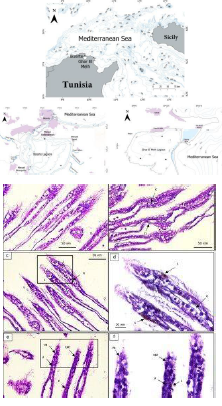
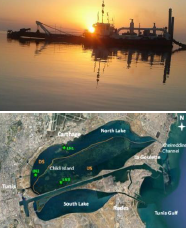
Through the study “Impact of Dredging on Diagenesis and Nutrient Release in a Restored Mediterranean Lagoon (Lagoon of Tunis, Tunisia)” by H. Ben Mna et al. (2024), researchers explored the ecological consequences of dredging interventions. Their findings indicate that, although dredging can temporarily improve water quality by clearing accumulated sediments, it may also trigger long-term nutrient release and diagenetic alterations that destabilize the lagoon’s ecological equilibrium.
This work highlights the importance of adopting sustainable dredging practices and monitoring strategies to mitigate negative environmental outcomes and preserve ecosystem health.
Assessing the Impact of Riverine Nutrients on Coastal Ecosystems in Northeast Tunisia
In the study “River Nutrient Inflows and Coastal Ecosystem Health in Northeast Tunisia’s Kelibia Mediterranean Region” by S. Melki et al., researchers examined how nutrient discharges from rivers influence nearby marine environments. The analysis revealed that excessive nutrient inputs—originating from agricultural runoff and urban effluents—trigger algal blooms, deplete oxygen levels, and disrupt fish habitats.
These outcomes underscore the urgency of implementing sustainable farming practices and enhancing wastewater treatment systems to curb nutrient pollution and safeguard Tunisia’s coastal biodiversity.
Understanding Fish Stock Structure for Sustainable Fisheries Management
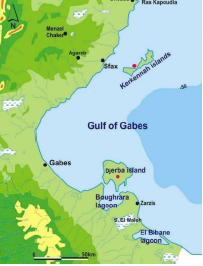
The study “Discriminant Stock Structure of Diplodus annularis (Perciformes, Sparidae) in Tunisian Waters Inferred from Saccular Otolith Morphometry and Microchemistry” by M. Ben Ghorbel et al. investigated the morphological and microchemical characteristics of otoliths from annular seabream populations collected around Djerba and Kerkennah Islands. Through detailed morphometric and chemical analyses, researchers identified distinct population structures within Tunisian waters.
These findings provide essential insights for designing region-specific fisheries management strategies, thereby contributing to the long-term sustainability of marine resources.
Assessing the Toxic Impact of Heavy Metals on Aquatic Organisms
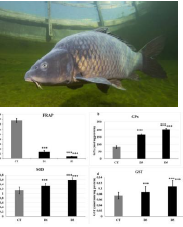
The research “Toxic Effects Assessment of Acute Cobalt Exposure on Stress Biomarkers Responses of Cyprinus carpio Intestine” by Chetoui et al. (2024) highlighted notable biochemical disturbances and stress responses in common carp following short-term cobalt exposure. The study demonstrated how trace metal contamination adversely affects the physiological integrity of aquatic species, reinforcing the urgent need for effective pollution prevention and environmental monitoring to preserve aquatic ecosystem health.
Evaluating Oil Pollution along Tunisia’s Northern Coast
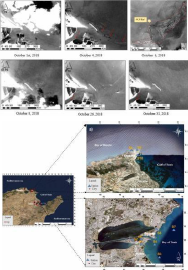
Belhadj et al., in the study “An Integrated GIS, Remote Sensing, Geochemical, and Ecological Approach for Correlating and Identifying Oil Contamination Sources of Tunisia’s Northern Coast”, assessed hydrocarbon pollution in the Gulf of Tunis, part of the western Mediterranean. Using GIS, remote sensing, geochemical analyses, and ecological monitoring, the research identified significant contamination in surface sediments, with total petroleum hydrocarbon (TPH) concentrations ranging from 1.4 mg/g to 8.26 mg/g. Major pollution sources include southern petrochemical industries and northern marine traffic. The study highlights substantial ecological impacts, particularly on benthic communities, and notes associated increases in eutrophication, underscoring the need for targeted pollution management strategies.
River Nutrient and trace elements Inflows and Coastal Ecosystem Health
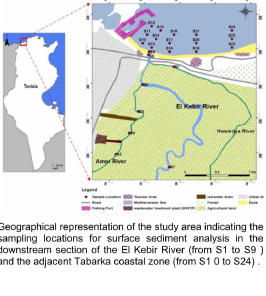
The study presents a geochemical assessment of surface sediments in Tabarka’s coastal ecosystem, focusing on inputs from the El Kebir River. Analysis of trace metals (Fe, Zn, Ni, Pb, Cu), total organic carbon (TOC), and total nitrogen (TN) revealed a significant anthropogenic influence. Pollution indices (PLI, CF-Pb, RI) classify the area as unpolluted to moderately polluted. Principal Component Analysis identified wastewater discharge and stormwater runoff as primary pollution sources. While current contamination is moderate, the ongoing accumulation of nutrients and metals poses a significant long-term risk to ecological health and functioning, underscoring an urgent need for enhanced environmental management.
Microplastic pollution
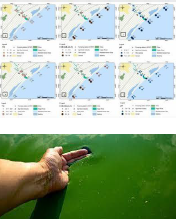
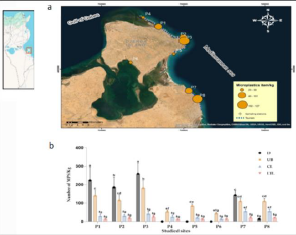
Guesmi et al. (2025) characterized microplastics (MPs) across eight beaches on Djerba Island, Tunisia, focusing on their occurrence, concentration, and polymer composition from degraded plastic waste. The research offers a critical evaluation of how anthropogenic pressures and natural coastal processes jointly shape MP distribution in the Mediterranean. Results showed concentrations ranging from 23 particles/kg at Gallela Beach to 126.67 particles/kg at Yati 2 Beach, with 65% of MPs accumulating in the dune zones. Polymer analysis identified polyethylene (PE) as the most abundant, followed by polypropylene (PP) and polystyrene (PS). The study highlights significant spatial variability, linking MP pollution directly to tourism, fishing, and urban runoff. Natural factors like wind and dune morphology also influenced distribution, emphasizing the urgent need for sustainable waste management for Djerba and adjacent coasts such as Zarzis.
conclusion
Significant research efforts at the University of Tunis El Manar have advanced the understanding and management of marine ecosystems in support of SDG 14. Studies on marine pollution, biodiversity, and ecological dynamics offer valuable guidance for policymakers and conservation practitioners. By promoting sustainable use and protection of Tunisia’s marine resources, these initiatives contribute to the health of both aquatic ecosystems and human populations. Ongoing collaboration among researchers, policymakers, and local communities remains crucial to achieving these objectives.