

Ensure inclusive and equitable quality education
and promote lifelong learning opportunities for all
Transforming our relationship with nature is key to a sustainable future

Pr. Halima Mahjoubi, UTM,SDG 4 Ambassador
The University of Tunis El Manar (UTM) is actively committed to contributing to
Sustainable Development Goal 4 (SDG 4), which aims to ensure
inclusive, equitable, and quality education and promote lifelong learning opportunities.

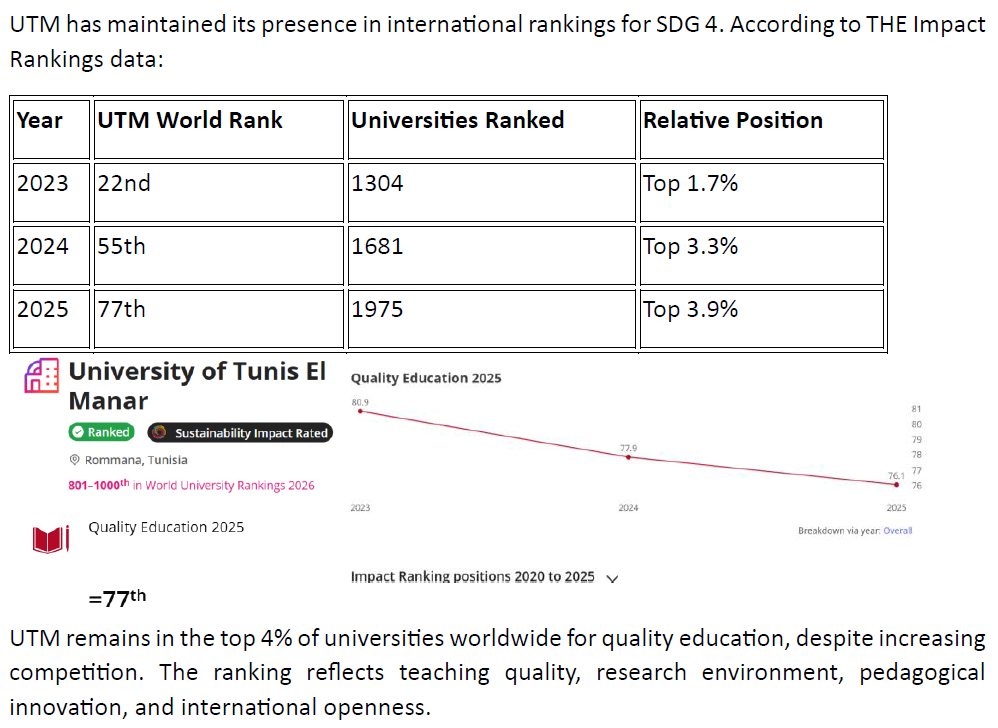
Innovative Dimension of Actions:
- Integration of the Japanese Kaizen pedagogical model achieving 85%+ student satisfaction.
- Certification training for teachers in AI, metaverse, and active pedagogies.
- Digitalization of 80% of processes for agile management.
- Creation of UTM-SHINE strategic monitoring system on SDGs and sustainability.
Importance for the Francophone Space:
The project improves quality standards in Tunisian higher education while offering a replicable model for French-speaking countries. It strengthens UTM’s influence in the Francophone space through inclusive approaches, North-South university partnerships, joint degrees, and shared accreditation practices, directly supporting SDG 4.
Establishment of Quality-Dedicated Structures:
Quality committees created in all 15 UTM institutions with clear missions: monitoring pedagogical indicators, internal audit, and coordination with central bodies.
Management and Monitoring Tools:
- Strategic dashboards for academic and administrative performance.
- Precise indicators to measure program effectiveness, student satisfaction, and pedagogical innovation.
Institutional Guides and Procedures:
- Sustainable governance guide published to harmonize practices.
- Standardized procedures for program planning, monitoring, and evaluation.
Certification Process and Continuous Improvement:
- Support for adopting ISO 9001 standards to strengthen internal management.
- Assistance to pilot institutes for extending the quality management system across UTM.
Quality Culture:
- Training of academic stakeholders in quality management.
- Quality integrated as a central element in decision-making and internal evaluations.
The University of Tunis El Manar (UTM) places the development of pedagogical and scientific skills of its faculty at the heart of its quality strategy. Actions aim to modernize teaching practices, integrate digital technologies, and promote innovative approaches to enhance learning.
4. Training and Pedagogical Capacity Building
Continuing Education for Teachers:
- Over 500 teachers trained in innovative pedagogical methods, integration of information and communication technologies (ICT), and online teaching tools (LMS).
- Deployment of specialized modules on artificial intelligence and active pedagogies to adapt teaching to scientific and societal developments.
Cultural and Sports Activities:
Events like the Badminton Championship and Creative Theatre Day promote holistic student development.
Introduction of Innovative Pedagogical Practices:
- Adoption of the Japanese Kaizen pedagogical model in several pilot institutions, achieving 85%+ student satisfaction.
- Organization of thematic schools in 50% of institutions to encourage the exchange of best practices and pedagogical excellence.
The University of Tunis El Manar (UTM) places the development of pedagogical and scientific skills of its faculty at the heart of its quality strategy. Actions aim to modernize teaching practices, integrate digital technologies, and promote innovative approaches to enhance learning.
4. Training and Pedagogical Capacity Building
Continuing Education for Teachers:
- Over 500 teachers trained in innovative pedagogical methods, integration of information and communication technologies (ICT), and online teaching tools (LMS).
- Deployment of specialized modules on artificial intelligence and active pedagogies to adapt teaching to scientific and societal developments.
Cultural and Sports Activities:
Events like the Badminton Championship and Creative Theatre Day promote holistic student development.
Introduction of Innovative Pedagogical Practices:
- Adoption of the Japanese Kaizen pedagogical model in several pilot institutions, achieving 85%+ student satisfaction.
- Organization of thematic schools in 50% of institutions to encourage the exchange of best practices and pedagogical excellence.
Accreditations and Standardization:
- 7 international accreditations: EUR-ACE, CIDMEF, ARQAA, etc.
- ISO 21001 certification for 10 institutions; ISO 9001 certification for UTM and IPT.
80% of administrative and pedagogical processes digitalized university-wide.
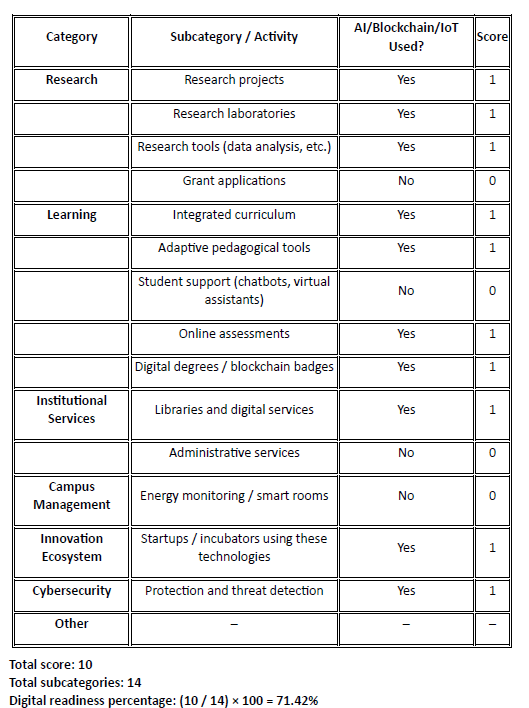
UTM has strengthened its digital infrastructure to support pedagogical and scientific innovation. Internal evaluation reveals that 71.42% of activities and services integrate technologies such as artificial intelligence, blockchain, and the Internet of Things (IoT).
This integration covers several areas:
- Research projects and laboratories using advanced digital tools.
- Adaptive learning platforms and tools to improve student experience.
- Online assessments, smart campus management, and digital institutional services.
- Cybersecurity and support for innovative startups and incubators.
These initiatives enable UTM to modernize its pedagogical practices, improve program efficiency, and prepare students with digital skills necessary to meet contemporary challenges.
University Degrees and Professional Masters:
UTM has developed job-oriented degree programs combining theoretical knowledge and practical skills, enabling students to meet local and international business needs.
- Continuing certification training (PRINCE2, PMP, cybersecurity, cloud): These programs offer professionals and students the opportunity to strengthen specialized skills and obtain recognized certifications, improving their employability and integration in technological and managerial sectors.
- Innovative hybrid pedagogies including generative AI, metaverse, immersive simulations: The university integrates advanced digital tools to enrich the learning experience, foster active learner engagement, and develop practical skills in realistic simulated environments.
- Accessibility to self-training platforms (MOOCs, LMS): UTM provides students and professionals with online learning resources, enabling flexible self-learning, personalized skills tracking, and pedagogical continuity despite geographical or temporal constraints.
Funding and Support for Socially Impactful Research:
Over 70 interdisciplinary projects funded, covering areas such as artificial intelligence, medical sciences, and digital technologies. These projects are selected based on their potential to address societal needs and generate concrete benefits for socio-economic stakeholders.
Increase in Scientific Output:
- The University of Tunis El Manar produced 8,215 publications between 2022 and 2024, demonstrating sustained growth in academic research.
- 694 publications (8.4%) rank among the top 10% most cited globally, and 947 publications (12.9%) were published in top-tier journals according to CiteScore, confirming the scientific quality of the work.
- International collaboration represents 52.3% of publications, reflecting the institution’s openness and commitment to global partnerships.
- Academic-business cooperation, although lower (1.1%), demonstrates the application of research to concrete projects and links with the socio-economic sector.
- The most cited publications, including studies on global health and epidemiology, illustrate the university’s scientific and societal impact.
- Indexed publications increased by over 70% between 2021 and 2024, reflecting continuous progress in quality and international visibility.
- Efforts have been made to encourage open access publishing and knowledge sharing within the scientific community.
Strengthening Socio-Economic Partnerships:
Over 60 active partnerships consolidated with companies, public institutions, and international organizations. These collaborations promote technology transfer, applied innovation, and development of concrete solutions for society.
- and British universities (Oxford).
- Transnational programs equipped with advanced laboratories and immersive pedagogical environments.
- Membership in several academic networks and cooperation bodies (to be completed).
Finalization of the Process to Obtain the “Entrepreneurial University” Label:
- Strengthening training, employability, and support actions for project leaders.
- Increased integration of open and inclusive education practices, and development of quality culture within academic communities.